
Article: Navratri 9 Days, 9 Colours 2026: Diamond Jewellery to Match Each Day
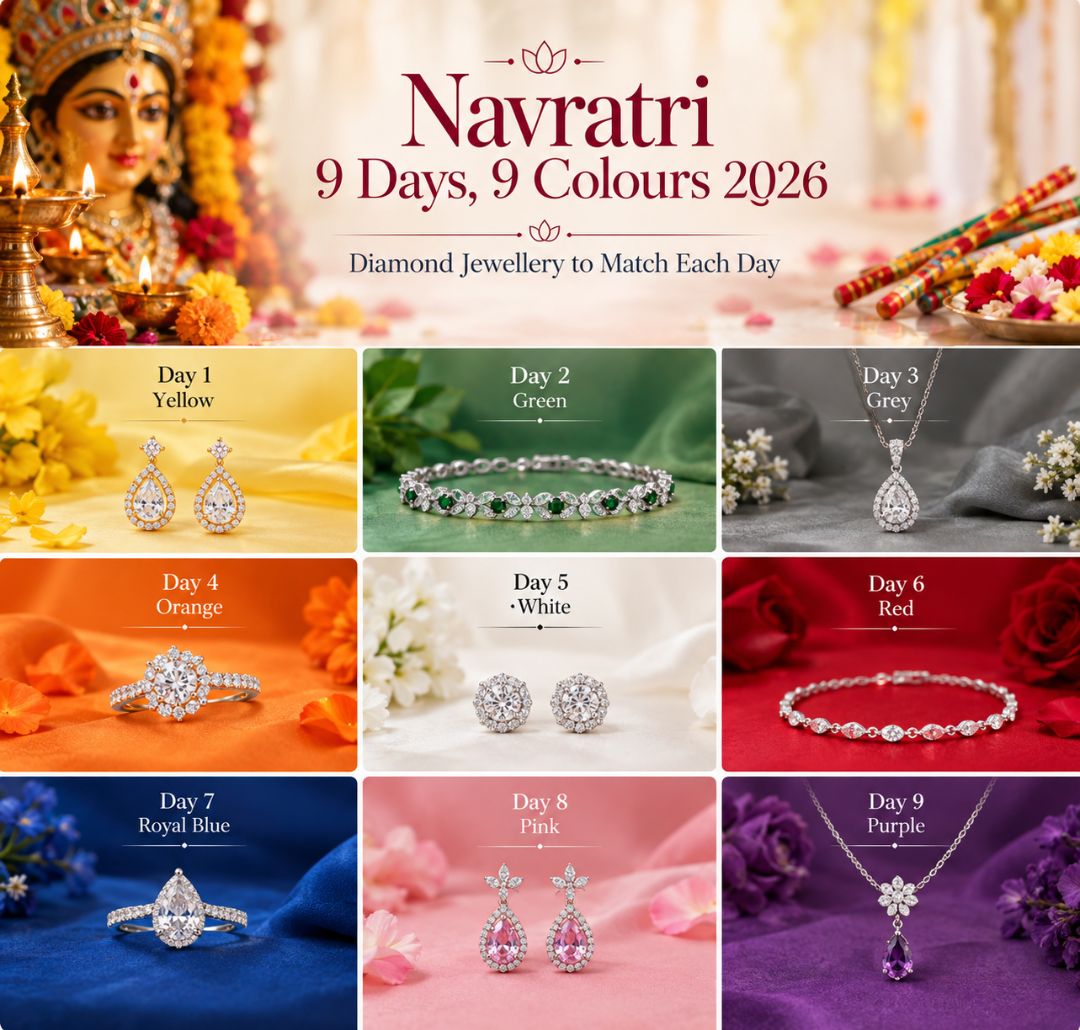
Navratri 9 Days, 9 Colours 2026: Diamond Jewellery to Match Each Day
Every year, Navratri outfits follow a simple rule: one colour a day, for nine days. It started as a way to dress for each form of Goddess Durga worshipped during the festival, and over time it's become one of the most fun parts of festive planning colour-coordinated kurtas, dupattas, bangles, and yes, jewellery too.
Jewellery is where a lot of people get stuck, though. Matching an outfit's colour is one thing; picking pieces that actually work with nine different shades over nine days is another. This is where diamond jewellery has an advantage it doesn't compete with colour, it complements it. A pair of diamond studs or a simple pendant sits well against orange, red, green, or peacock blue without ever looking out of place.
This guide covers the 2026 Navratri colour list with dates, what each colour is traditionally associated with, and practical jewellery ideas including diamond pieces for each day, plus Garba-specific tips and quick-reference styling tables.
Quick note on dates and sequence: Navratri colour sequences are linked to the weekday the festival begins on, which is why the order changes from year to year. For Sharad Navratri 2026 (11–19 October), most current sources list the same nine-colour order used below. A few sources present a different sequence or substitute pink for one of the shades this can vary by region, community and family tradition, so it's worth checking your local Panchang if you follow a specific one.
Navratri 2026 Colour List: Quick Reference Table
| Navratri Day | Date (2026) | Colour | Colour Significance | Jewellery Style | Suggested Diamond Jewellery |
|---|---|---|---|---|---|
| Day 1 | 11 Oct (Sun) | Orange | Associated with warmth and energy | Bold, statement-friendly | Diamond drop earrings |
| Day 2 | 12 Oct (Mon) | White | Associated with purity and calm | Minimal, clean lines | Diamond stud earrings |
| Day 3 | 13 Oct (Tue) | Red | Associated with passion and vigour | Rich, traditional | Diamond tennis bracelet |
| Day 4 | 14 Oct (Wed) | Royal Blue | Associated with elegance | Structured, refined | Diamond pendant |
| Day 5 | 15 Oct (Thu) | Yellow | Associated with happiness | Bright, playful | Layered diamond necklace |
| Day 6 | 16 Oct (Fri) | Green | Associated with growth and freshness | Nature-inspired, light | Diamond ring |
| Day 7 | 17 Oct (Sat) | Grey | Associated with balance | Understated, modern | Minimal diamond studs |
| Day 8 | 18 Oct (Sun) | Purple | Associated with grandeur | Regal, ornate | Statement diamond earrings |
| Day 9 | 19 Oct (Mon) | Peacock Green | Associated with individuality | Distinctive, expressive | Diamond necklace |
Ashtami and Navami tithis both fall close to Day 8–9 in 2026, so if you follow specific puja days like Kanya Pujan, check your local Panchang rather than assuming they line up exactly with the colour calendar above.
Day-by-Day: Colours and Jewellery Ideas
Day 1: Orange — Jewellery to Match
Orange kicks off Navratri and is commonly linked to energy and enthusiasm. It works well with gold-toned or embroidered outfits — think an orange chaniya choli or a simple orange kurta.
For jewellery, this is a good day to go slightly bold since orange is a strong colour on its own. Diamond drop earrings add movement and catch light without clashing with the outfit's warmth. If you're keeping it simple, a pair of statement studs works just as well.
Styling tip: Since orange outfits are often busy with embroidery, keep the jewellery to one focal piece — earrings or a pendant, not both at statement size.
Day 2: White — Jewellery to Match
White is associated with purity and calm, and it's one of the easiest colours to build a jewellery look around because almost anything shows up well against it.
Diamond stud earrings are a natural fit here — clean, understated, and they let the white outfit stay the visual focus. If you want a bit more presence, a delicate diamond pendant on a thin chain works too.
Styling tip: White is a good day to try minimal everyday diamond jewellery — pieces you'll actually reach for after Navratri as well.
Day 3: Red — Jewellery to Match
Red is traditionally linked to passion and vitality, and it's one of the most popular Navratri and festive colours overall. Red outfits are often richer in fabric and embroidery — lehengas, silk kurtas, heavily worked dupattas.
A diamond tennis bracelet is a good match here — it adds sparkle at the wrist without competing with an already-detailed outfit. If you're dancing at Garba later in the evening, the bracelet also stays secure and doesn't get in the way.
Styling tip: With red, let the outfit lead. Diamonds in white or rose gold settings give contrast against red without looking mismatched.
Day 4: Royal Blue — Jewellery to Match
Royal blue is often associated with elegance and a sense of composure. It photographs well and pairs nicely with both gold and white-metal jewellery.
A diamond pendant necklace complements royal blue particularly well — the contrast between the deep blue and bright stone is one of the more striking pairings across the nine days.
Styling tip: If your outfit has a high neckline, skip the necklace and go for diamond drop earrings instead so the jewellery still has somewhere to sit.
Day 5: Yellow — Jewellery to Match
Yellow is commonly tied to happiness and positivity, and it's a favourite for daytime Navratri events because it photographs bright and cheerful.
A layered diamond necklace works nicely against yellow — it adds dimension without overwhelming a colour that's already vivid. For a lighter option, diamond studs paired with bangles keep things simple.
Styling tip: Yellow is bold enough on its own, so this is a good day to lean minimal with jewellery rather than statement pieces.
Day 6: Green — Jewellery to Match
Green is associated with growth and freshness, and it tends to pair beautifully with diamonds — the cool white sparkle sits nicely against most shades of green, from mint to emerald-toned outfits.
A diamond ring is a nice choice for this day — visible, versatile, and it doesn't require matching to a neckline or outfit cut the way earrings or necklaces do.
Styling tip: If your green outfit has gold detailing, a diamond ring in a warmer-toned setting ties the look together.
Day 7: Grey — Jewellery to Match
Grey stands for balance in the traditional colour associations, and it's become more popular in recent years as Navratri fashion has moved toward more muted, contemporary palettes.
Minimal diamond studs suit grey well — the colour is neutral enough that jewellery becomes the point of sparkle in an otherwise understated outfit.
Styling tip: Grey is a good base for statement jewellery too, if you want to go bigger on a quieter day. Either direction works.
Day 8: Purple — Jewellery to Match
Purple is often linked to grandeur and richness, and outfits in this shade — especially for Ashtami, which many families observe close to this day in 2026 — tend to be more elaborate.
Statement diamond earrings suit purple's richness well, especially chandelier or halo-style pieces that catch light against the deeper tone.
Styling tip: If Ashtami or Kanya Pujan falls on this day for your family, you may want jewellery that photographs well for the occasion — statement earrings tend to show up better than a subtle pendant.
Day 9: Peacock Green — Jewellery to Match
The final day's colour, peacock green, is associated with individuality and freshness — a fitting close to the nine-day colour sequence.
A diamond necklace works well here, especially one with some structure to it, since peacock green tends to be a statement colour in its own right.
Styling tip: This is often the day people wear their most put-together look for the festival's close, so jewellery can be a little more considered — a necklace and earring set rather than a single piece.
How to Choose Jewellery for Navratri Outfits
A few general principles that apply across all nine days:
- Matching vs contrasting: Matching jewellery metal tone to your outfit's dominant colour (warm gold with warm colours, white metal with cooler tones) is the safer route, but diamonds in either setting work as a neutral that doesn't need to match at all.
- Heavily embroidered outfits: Keep jewellery to one statement piece — either earrings or a necklace, not both — so it doesn't compete with the outfit's detailing.
- Minimalist outfits: These can carry more jewellery. A layered necklace or statement earrings have room to stand out.
- Gold vs white-metal looks: Both work with diamonds. Gold settings feel warmer and more traditional; white metal feels more contemporary.
- Minimal jewellery for Garba: Lightweight studs, a thin bracelet, small hoops — anything that won't swing or catch on dupattas while dancing.
- Statement jewellery for festive nights: Save chandelier earrings or layered necklaces for evenings when you're not dancing continuously.
- Choosing by neckline: High necklines pair better with earrings or a bracelet than a necklace; deeper or boat necklines have more room for a pendant.
- Daytime vs evening: Daytime events (temple visits, family gatherings) suit smaller, everyday pieces. Evening Garba and Dandiya nights can take slightly more sparkle.
Best Diamond Jewellery for Garba & Dandiya Nights
Garba and Dandiya involve hours of movement, so comfort matters as much as how a piece looks.
- Comfortable earrings: Studs or small huggie-style earrings stay in place better than long danglers during active dancing.
- Lightweight necklaces: A thin diamond pendant or chain won't shift around or catch on dupattas the way a heavier necklace can.
- Rings: A simple diamond ring is one of the easiest pieces to wear through hours of dancing — no clasp to worry about, minimal movement.
- Bracelets: Tennis bracelets with secure clasps work better than loose bangles for continuous hand movement (dandiya sticks included).
- What transitions well: Pieces like diamond studs, a simple pendant, or a ring aren't festival-specific — they move easily from Navratri into everyday wear, work events, or other occasions afterward.
Secure fittings matter here more than on quieter days — if a piece has a clasp or back that feels loose, it's worth double-checking before a night of continuous movement.
Where The6C Fits In
If you're putting together jewellery for Navratri and want pieces that don't feel like a one-time festival purchase, lab-grown diamond jewellery is worth considering. The6C's collection includes diamond earrings, pendants, rings, and bracelets designed to work across multiple occasions — the same diamond stud earrings or tennis bracelet you wear for Garba can go straight into your everyday or work wardrobe once the festival is over.
That versatility is really the appeal for Navratri specifically: instead of buying separate jewellery for each of the nine colours, a few well-chosen diamond pieces — studs, a pendant, a ring — can be styled across most of the colour palette without needing to match every single day.
9 Navratri Jewellery Styling Ideas at a Glance
| Day | Outfit Colour | Jewellery Look | Best For |
|---|---|---|---|
| 1 | Orange | Diamond drop earrings | Statement daytime look |
| 2 | White | Diamond stud earrings | Everyday, minimal |
| 3 | Red | Diamond tennis bracelet | Festive evening |
| 4 | Royal Blue | Diamond pendant | Structured, elegant looks |
| 5 | Yellow | Layered diamond necklace | Daytime, photo-friendly |
| 6 | Green | Diamond ring | Versatile, low-maintenance |
| 7 | Grey | Minimal diamond studs | Understated, modern |
| 8 | Purple | Statement diamond earrings | Ashtami/festive occasions |
| 9 | Peacock Green | Diamond necklace | Festival close, dressed-up look |
FAQs
1. What are the 9 colours of Navratri in 2026?
For Sharad Navratri 2026 (11–19 October), the commonly followed sequence is Orange, White, Red, Royal Blue, Yellow, Green, Grey, Purple, and Peacock Green. The order is based on the weekday Navratri begins, so it changes each year, and some regional traditions vary slightly.
2. What jewellery should I wear with Navratri colours?
Diamond jewellery works across most Navratri colours since it acts as a neutral rather than competing with the outfit's shade. Studs and pendants suit lighter, minimal outfits; statement earrings and layered necklaces suit richer, more embellished ones.
3. Which diamond jewellery is best for Garba?
Lightweight, secure pieces — diamond studs, a thin pendant, a ring, or a tennis bracelet with a good clasp — hold up best through hours of dancing.
4. Can I wear diamond jewellery with a traditional Navratri outfit?
Yes. Diamond jewellery pairs well with both traditional and contemporary Navratri outfits, in either gold or white-metal settings depending on the look you're going for.
5. What jewellery looks good with a lehenga or chaniya choli?
Statement earrings or a pendant necklace generally work well, depending on the neckline and how heavily embroidered the outfit is — the more detailed the outfit, the simpler the jewellery should be.
6. Is lab-grown diamond jewellery suitable for festive occasions?
Yes. Lab-grown diamonds have the same physical and optical properties as mined diamonds, so they work the same way for festive styling — the difference is in origin, not appearance.
7. What jewellery should I wear for Dandiya night?
Similar principles to Garba apply: comfortable, secure pieces that won't swing or catch — studs, a simple bracelet, or a ring rather than long, heavy earrings.
8. How can I style diamond earrings for Navratri?
Match the earring style to your outfit's detail level — bold or drop earrings for simpler outfits, studs or smaller pieces for heavily embroidered ones — and consider comfort if you'll be dancing.
9. Can Navratri jewellery be worn after the festival?
Yes, especially diamond pieces like studs, pendants, rings, and bracelets, which aren't festival-specific and work well for everyday or occasion wear year-round.