
Article: Lab Grown Diamond Rings for Women: Best Designs & Prices in India 2026
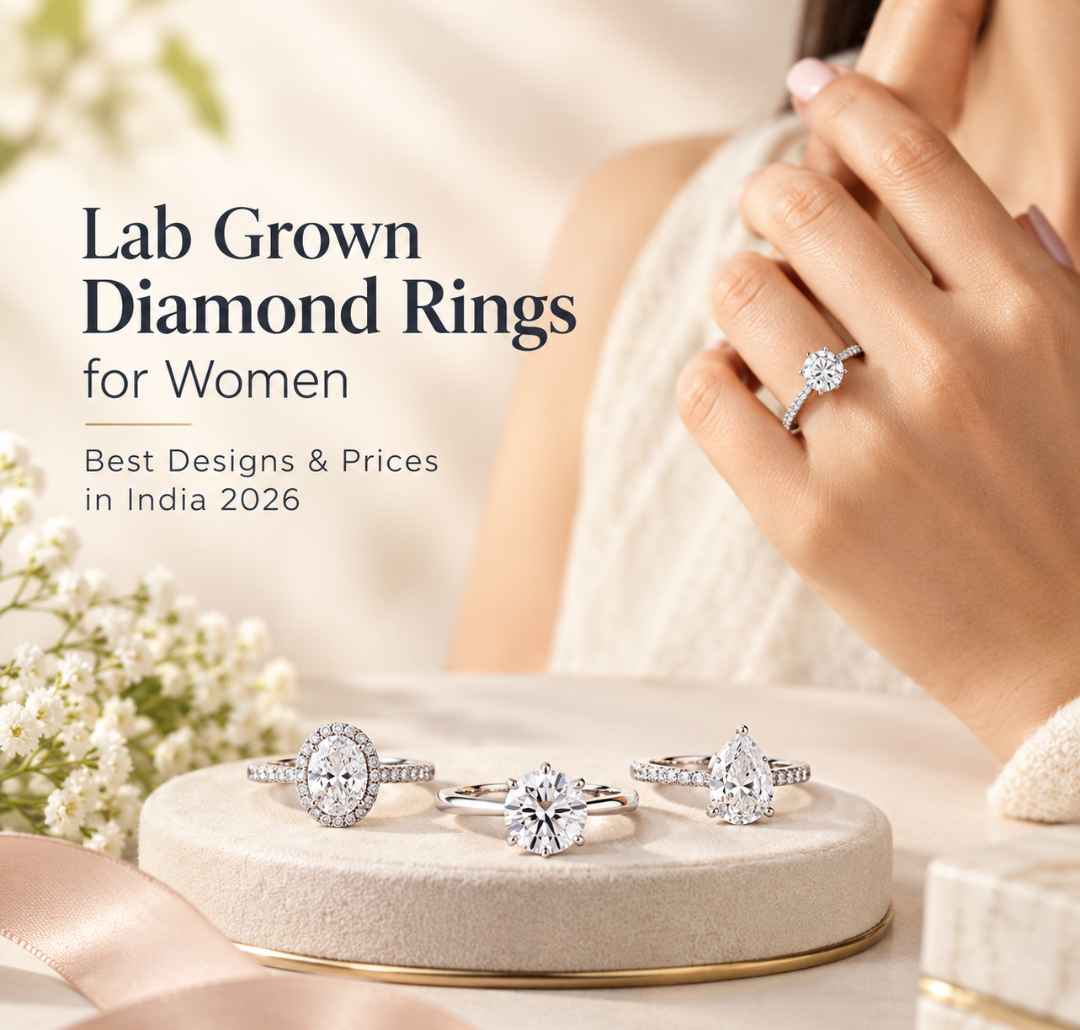
Lab Grown Diamond Rings for Women: Best Designs & Prices in India 2026
If you are comparing lab grown diamond rings for women in 2026, you are probably weighing three things: which design suits you, what the ring will cost, and how to be sure you are getting a genuine, certified diamond.
Lab grown diamonds are real diamonds, grown in a controlled environment. That gives buyers more choice in carat weight, shape and setting for a given budget. This guide covers popular designs, the factors that decide price, how to choose by occasion, and what to check before you order.
Explore Lab Grown Diamond Rings
What Are Lab Grown Diamond Rings?

A lab grown diamond ring is a ring set with a diamond that has been grown in a laboratory instead of being mined. These diamonds are pure carbon in a cubic crystal structure, the same as natural diamonds, and rate 10 on the Mohs hardness scale.
They are grown mainly by two methods:
- HPHT (High Pressure High Temperature): recreates the pressure and heat under which diamonds form in the earth.
- CVD (Chemical Vapour Deposition): builds the diamond layer by layer from a carbon-rich gas.
Lab grown diamonds are different from diamond simulants such as cubic zirconia, moissanite or white sapphire. Simulants only look similar and have a different chemical composition.
Reputable labs such as IGI grade lab grown diamonds on the 4Cs and state on the report that the stone is laboratory-grown. Always ask for the grading report before buying.
Why Are Lab Grown Diamond Rings Popular Among Women in 2026?
Buyers usually choose them for practical reasons:
- Design variety: solitaires, halos, eternity bands and statement rings are widely available.
- Specifications you can compare: a graded stone comes with carat, colour, clarity and cut details.
- Pricing flexibility: buyers can often choose a larger or better-graded stone within a set budget. Exact savings depend on specifications, so compare like for like.
- Modern styling: slim bands, east-west settings and stackable rings suit both office and evening wear.
- Multiple uses: the same category covers everyday rings, engagement rings, wedding jewellery and gifts.
Best Lab Grown Diamond Ring Designs for Women
No single design is best for everyone. Here is how the main styles differ.
Lab Grown Diamond Solitaire Rings
- Design character: one centre stone, minimal setting, timeless look.
- Best occasion: engagement, anniversary, daily wear.
- Styling suitability: works with both Indian and western outfits. A low-profile setting is easier for everyday wear, while a higher setting gives more presence.
- Who may prefer it: buyers who like clean, understated jewellery.
Round, oval and emerald are common shape choices for solitaires. The6C's Twirl Forest Solitaire Diamond Ring is a solitaire with paved diamonds, available in 14KT and 18KT gold.
Lab Grown Diamond Halo Rings
- Design character: a centre diamond surrounded by a ring of smaller diamonds, which makes the centre stone look larger.
- Best occasion: engagement, birthdays, evening events.
- Styling suitability: visible from a distance, pairs well with festive and occasion wear.
- Who may prefer it: buyers who want more sparkle and presence from a moderate centre stone.
For a similar size-enhancing effect without a full halo, the Sparkling Mehndi Designer Diamond Ring pairs a centre stone with triple-set diamond shoulders.
Lab Grown Diamond Three-Stone Rings
- Design character: three diamonds in a row, often read as past, present and future.
- Best occasion: engagement, anniversary, milestone gifts.
- Styling suitability: balanced and symbolic; side stones can differ in shape from the centre.
- Who may prefer it: buyers who want a design with meaning built in.
Lab Grown Diamond Cluster Rings
- Design character: several smaller diamonds grouped to look like one larger stone or a floral shape.
- Best occasion: casual gifting, parties, festive wear.
- Styling suitability: a broad, sparkly look without a single large centre stone.
- Who may prefer it: buyers who prefer a detailed, decorative style.
Lab Grown Diamond Eternity Rings
- Design character: diamonds running around the band, either fully or partly.
- Best occasion: anniversaries, milestones, wedding stacks.
- Styling suitability: works alone or stacked with a solitaire. Check comfort, as some full eternity bands are harder to resize.
- Who may prefer it: buyers who want a continuous line of sparkle.
The Sparkling Sunlight Diamond Ring is a sleek diamond band, a simple starting point for stacking with a solitaire.
Lab Grown Diamond Statement Rings
- Design character: larger, sculptural or diamond-heavy designs.
- Best occasion: weddings, parties, formal events.
- Styling suitability: works as the main jewellery piece of an outfit.
- Who may prefer it: buyers who like bold, noticeable jewellery.
Lab Grown Diamond Ring Prices in India 2026
The price of a lab grown diamond ring depends on the stone, the metal and the making, not on a fixed rate per carat. To give a real reference point, here are four rings from The6C, with prices as listed on their product pages in September 2026:
| Ring | Design | 14KT Gold | 18KT Gold |
|---|---|---|---|
| Sparkling Sunlight Diamond Ring | Sleek diamond band | Rs. 47,878 | Rs. 54,362 |
| Twirl Forest Solitaire Diamond Ring | Solitaire with paved diamonds | Rs. 54,067 | Rs. 62,006 |
| Sparkling Mehndi Designer Diamond Ring | Centre stone with triple-set diamond shoulders | Rs. 75,133 | Rs. 84,396 |
| Entwined Hearts Diamond Ring | Paved diamonds around a centre stone | Rs. 79,055 | Rs. 88,318 |
Two things stand out. On these designs, the price stays the same across ring sizes and across yellow, white and rose gold. Only the gold purity changes it: moving from 14KT to 18KT adds roughly Rs. 6,500 to Rs. 9,300. These are four designs, not the whole collection, and prices can change, so check the product page before ordering.
| Factor | How It Can Affect Price | What Buyers Should Consider |
|---|---|---|
| Carat weight | Price rises with size, often steeply at popular sizes such as 1 ct and above | Decide whether you want visual size or total weight; a well-cut stone can look larger than its weight suggests |
| Cut | Better cut usually costs more | Cut affects sparkle more than any other factor, so avoid compromising here |
| Colour | Colourless grades usually cost more than near-colourless | Near-colourless stones can look white once set, especially in yellow or rose gold |
| Clarity | Higher grades cost more | Eye-clean stones (commonly VS to SI range) often give the best value |
| Diamond shape | Some shapes cost more or look larger per carat | Compare shapes at the same carat weight |
| Certification | Graded stones with reports are priced on verified specifications | Check the report number matches the ring |
| Metal | 14KT, 18KT and platinum differ in cost | Check purity and BIS hallmark on gold |
| Ring setting | Halo, three-stone and pavé involve more stones and labour | Count the total diamond weight, including side stones |
| Craftsmanship | Finishing, stone setting and design detail add to cost | Look at close-up photos and the product description |
| Brand and product specifications | Policies, packaging and service are part of the price | Compare what is included, not only the headline price |
Why can two similar-looking rings have different prices? One may have a better cut grade, better colour or a certified centre stone, while the other has lower grades. The metal purity, total diamond weight and the amount of setting work can also differ. Compare specifications side by side, not photos.
Shop Lab Grown Diamond Rings for Women
Best Lab Grown Diamond Rings for Different Occasions
Everyday Wear
Minimal solitaires, slim bands and low-profile settings. Look for secure settings that do not snag on clothes or hair. The Sparkling Sunlight Diamond Ring or the Twirl Forest Solitaire suit daily wear.
Engagement
Solitaire, halo and three-stone styles are common. The Twirl Forest Solitaire is a classic option; the Sparkling Mehndi Designer Diamond Ring gives more visual size.
Wedding
Statement rings and diamond-heavy bands work well for the ceremony and reception. The Sparkling Mehndi Designer or the Entwined Hearts Diamond Ring suit diamond-heavy styles.
Anniversary
Eternity and three-stone rings suit milestone gifts. The Entwined Hearts Diamond Ring or the Sparkling Sunlight band both work here.
Birthday or Gifting
Versatile, easy-to-style rings such as a simple solitaire, a small cluster or a stackable band. The Sparkling Sunlight band is a simple, versatile choice.
How to Choose a Lab Grown Diamond Ring for Women
- Diamond shape: decides the overall look. See the comparison below.
- Carat weight: the weight of the stone. Two stones of the same carat can look different in size depending on shape and cut.
- Cut: how well the diamond is proportioned, which drives sparkle.
- Colour: graded from D (colourless) downwards. Near-colourless grades are often good value.
- Clarity: how many inclusions are present. Aim for eye-clean.
- Certification: ask for a grading report from a recognised lab such as IGI.
- Ring metal: white, yellow or rose gold, platinum or silver. Match it to skin tone and other jewellery.
- Ring size: confirm before ordering (see the sizing section).
- Setting: prong, bezel, halo or pavé. Bezel settings protect the stone more; prongs let in more light.
- Lifestyle: if you type, cook or work with your hands, choose a lower, secure setting.
- Occasion: engagement, gift or daily wear changes what suits you.
- Budget: set a total budget and prioritise cut and certification over chasing extra carat weight.
Which Diamond Shape Is Best for Women's Rings?
No shape wins for everyone. The right one depends on taste, finger shape and setting.
| Diamond Shape | Overall Look | Common Styling | Suitable For |
|---|---|---|---|
| Round | Classic, high sparkle | Solitaire, halo, eternity | Traditional and versatile buyers |
| Oval | Elongated, can make fingers look longer | Solitaire, halo, east-west | Modern, elegant look |
| Emerald | Step-cut, mirror-like "hall of mirrors" effect | Solitaire, three-stone | Clean, sophisticated styles |
| Pear | Teardrop, distinctive | Solitaire, halo | Unique, feminine designs |
| Princess | Square, sharp corners, bright | Solitaire, three-stone | Contemporary look |
| Cushion | Soft square with rounded corners | Halo, vintage-inspired | Romantic, vintage style |
| Marquise | Long, pointed ends, looks larger per carat | Solitaire, accents | Bold, elongated style |
Lab Grown Diamond Ring vs Natural Diamond Ring
Both are real diamonds. The differences are in origin, pricing and resale.
| Point | Lab Grown Diamond Ring | Natural Diamond Ring |
|---|---|---|
| Origin | Grown in a laboratory | Formed in the earth over a very long time |
| Characteristics | Same chemical composition and crystal structure | Same chemical composition and crystal structure |
| Certification | Graded by labs such as IGI; report states lab grown | Graded by labs such as GIA and IGI |
| Pricing | Usually lower for comparable specifications | Usually higher for comparable specifications |
| Design availability | Wide range of designs and sizes | Wide range of designs and sizes |
| Buying considerations | Check certificate and retailer policies | Check certificate and retailer policies |
| Resale | Depends on the retailer's buyback or exchange policy; not guaranteed | Depends on the market and buyer; retail price is not usually recovered |
The choice depends on what matters to you: origin, budget or a specific specification.
Are Lab Grown Diamond Rings Real Diamonds?
Yes, lab grown diamond rings are real diamonds. They have the same chemical composition (carbon), crystal structure and hardness as natural diamonds. The difference is origin: one is grown in a lab, the other formed in the earth.
Both are different from diamond simulants such as cubic zirconia and moissanite, which are other materials that only resemble diamonds. A grading report from a recognised lab confirms what you are buying.
Are Lab Grown Diamond Rings Good for Engagements?
Yes, many buyers choose them for engagement. What matters is the ring's design and specifications, not only the stone's origin.
- Solitaire: timeless and simple, with the diamond as the focus.
- Halo: gives more visual size and sparkle.
- Three-stone: adds symbolic meaning.
- Diamond shape: choose one you will still like in years.
- Certification: ask for a grading report.
- Setting: choose a secure setting for daily wear.
- Personal style and budget: decide these first and let them guide the rest.
How to Buy Lab Grown Diamond Rings Online in India
- Decide the purpose: engagement, gift, or everyday wear.
- Choose a budget: include the metal and setting in the total.
- Select the diamond shape: use the table above as a guide.
- Compare the 4Cs: prioritise cut, then balance colour, clarity and carat.
- Check certification: confirm the report and that the stone matches it.
- Select the metal: The6C ring pages offer 14KT and 18KT gold in yellow, white and rose.
- Confirm ring size: the size selector runs from 8 to 22. Check your size against the retailer's guide.
- Review product specifications: read the description, metal purity and certificate details before ordering.
- Check policies: The6C states a 15-day return for unused rings in original packaging with the invoice, and a lifetime exchange and buyback. Customised or engraved pieces are not eligible for the 15-day return or exchange; lifetime exchange and buyback still apply. It also states a 1-year replacement warranty for quality issues that cannot be repaired, which excludes misuse and loss of parts. Read the full policy before buying.
- Place the order: the ring pages above state a delivery timeline of 15-17 working days, with free shipping.
Want something personal? The6C also offers customisation, or browse the ready-to-ship rings.
How to Find the Right Ring Size
- Measure an existing ring: measure its inside diameter and match it to the retailer's size chart.
- Use a paper strip or string: wrap it around the finger, mark where it overlaps and measure the length.
- Visit a jeweller: ask for a ring-sizer measurement.
Measure at the end of the day, when fingers are at their usual size, and avoid measuring when your hands are cold. Wider bands fit tighter than thin bands. Indian, US and UK ring sizes differ, so always check the retailer's sizing guide before ordering.
How to Care for a Lab Grown Diamond Ring
- Clean regularly: soak in warm water with mild soap and use a soft brush.
- Store safely: keep it in a soft pouch or box, separate from other jewellery.
- Avoid harsh chemicals: remove it before using bleach, cleaning products or chlorinated pool water.
- Remove during activities: gym, cooking, gardening and heavy housework.
- Check the setting: look for loose prongs or a stone that moves.
- Get professional inspection: have it checked by a jeweller periodically, or sooner if the ring is hit or shows damage.
Lab Grown Diamond Rings for Gifting
Match the ring to the person's daily style and the occasion.
- Wife: a solitaire or eternity band for an anniversary, or a stackable band that matches existing jewellery.
- Girlfriend: a simple solitaire or small cluster; check her existing jewellery and metal preference.
- Mother: a classic solitaire or three-stone ring for a milestone birthday or anniversary.
- Sister: a versatile, everyday-style ring.
- Anniversary: eternity and three-stone rings suit the theme.
- Birthday: a simple solitaire or stackable band.
- Wedding: a statement ring, or a band to pair with an engagement ring.
- Valentine's Day: a solitaire or heart-themed design if it matches her taste. The Entwined Hearts Diamond Ring is a natural fit here.
- Milestone occasions: three-stone or eternity rings, chosen for the meaning behind them.
Order early. The ring pages above state a delivery time of 15-17 working days, so allow for it before an anniversary or birthday. If you are unsure about size, choose a design that can be resized, and check the retailer's exchange policy first. Also see The6C's earrings and pendants if you want to pair the ring with another piece.
Explore The6C's Lab Grown Diamond Jewellery
Frequently Asked Questions
1. Are lab grown diamond rings real diamonds?
Yes. Lab grown diamonds have the same chemical composition (carbon), crystal structure and hardness as natural diamonds. The difference is origin, as they are grown in a controlled laboratory environment. They are different from simulants like cubic zirconia or moissanite, which are other materials.
2. What is the price of a lab grown diamond ring in India in 2026?
Prices depend on carat, cut, colour, clarity, shape, metal and setting. On The6C, the four rings featured in this guide are priced from Rs. 47,878 (14KT) to Rs. 88,318 (18KT), as listed in September 2026. Switching from 14KT to 18KT adds roughly Rs. 6,500-9,300 on these designs. Check the product page for the current price.
3. Are lab grown diamond rings good for engagement?
Yes, many buyers choose them. The right ring depends on the design, diamond shape, certification, setting quality, personal style and budget. Solitaire, halo and three-stone designs are common engagement choices. Focus on the ring's specifications and how comfortable it is for daily wear.
4. Which lab grown diamond ring is best for women?
There is no single best ring. A solitaire suits classic, everyday wear; a halo gives more sparkle; a three-stone ring adds meaning; an eternity band suits milestones. Choose based on your daily routine, personal style, occasion and budget.
5. Which diamond shape is best for a women's ring?
No shape is best for everyone. Round is classic and bright, oval looks elongated, emerald is sleek, pear is distinctive, and cushion is soft and romantic. Try different shapes if you can, and choose the one that suits your style and setting.
6. Are lab grown diamond rings certified?
Many come with a grading report from labs such as IGI, stating the 4Cs and that the stone is lab grown. The6C lists its jewellery as certified. Confirm the certificate details for your specific ring before ordering, and keep the certificate safe, since exchanges may need it.
7. How do I choose a lab grown diamond ring?
Start with the purpose and budget, then choose the diamond shape, setting and metal. Compare the 4Cs, prioritising cut, and check the certification. Confirm your ring size and review the product specifications. Compare designs across the collection before you decide.
8. Can lab grown diamond rings be worn every day?
Yes, diamonds are very hard, and a secure setting makes daily wear practical. Low-profile solitaires and bezel settings are often chosen for everyday use. Remove the ring during heavy activities, and have the setting checked periodically.
9. Are lab grown diamond rings worth buying?
It depends on your priorities. You get a real diamond, wide design choice and often a lower price than natural for similar specifications. Check certification and policies too. The6C, for example, offers a 15-day return and a lifetime exchange and buyback policy with stated deduction terms, so read the terms before you buy.
10. Where can I buy lab grown diamond rings online in India?
Buy from jewellers that publish clear specifications, certification and policies. The6C sells lab grown diamond rings for women online, with 14KT and 18KT gold in yellow, white and rose, sizes 8 to 22, free shipping and a stated delivery time of 15-17 working days on these ring pages. Compare designs and terms before ordering.
11. Do lab grown diamond rings have resale value?
Resale depends on the seller's policy and market demand, and is not guaranteed. The6C states a lifetime buyback: 95% of metal value, 85% of diamond value and 75% of solitaire value at prevailing rates, excluding making charges and taxes, with deductions for any discounts used. Read the current policy before buying.
12. How should I care for a lab grown diamond ring?
Clean it with warm water, mild soap and a soft brush. Store it separately in a soft pouch. Keep it away from bleach and harsh chemicals, and remove it during gym, cooking or cleaning. Have the prongs and setting checked by a jeweller periodically.