
1 Carat Lab Grown Diamond Ring Price in India 2026: The Honest Breakdown Jewellers Won't Give You
You're ready to buy a diamond ring. You open five websites, and the prices for what looks like the same 1-carat diamond range from ₹40,000 to ₹4 lakh.
Confusing? Completely.
Most first-time buyers in India face this exact problem. The carat weight looks identical, the photos look identical, yet one ring costs ten times more than another. This guide explains what a 1 carat lab grown diamond ring price in India in 2026, why prices vary so widely, and how to make sure you pay for quality not for markup.
What Is the 1 Carat Lab Grown Diamond Ring Price in India in 2026?
Quick answer: In 2026, a 1 carat lab grown diamond rings in India typically costs between ₹40,000 and ₹1,20,000, depending on diamond quality, certification, and the gold setting. The most common range for a well-made, IGI-certified solitaire in 18K gold is ₹50,000–₹90,000.
Here is how the market breaks down by segment:
| Segment | Price Range | What You Get |
|---|---|---|
| Budget | ₹40,000 – ₹60,000 | SI clarity, G–H colour, simple 14K/18K gold band, IGI certified |
| Mid-Range | ₹60,000 – ₹90,000 | VS–VVS clarity, F–G colour, excellent cut, classic solitaire or halo in 18K gold |
| Premium | ₹90,000 – ₹1,50,000+ | DEF colour, VVS–IF clarity, ideal cut, designer settings, heavier gold work |
Two things to remember when reading these numbers:
- The loose diamond and the ring setting are priced separately. A 1 carat IGI-certified lab grown diamond on its own can start around ₹25,000–₹45,000. The gold, craftsmanship, and design make up the rest.
- Gold rates in India directly affect the final price. A heavier 18K setting adds more than a minimal band.
Why Do Prices Vary So Much?
Two rings can both say "1 carat lab grown diamond" and still differ by ₹60,000 or more. Here is exactly where the difference comes from.
Cut. This is the most important factor for sparkle, and the most commonly compromised one. An excellent or ideal cut reflects light beautifully. A poor cut makes even a high-clarity diamond look dull. Better cuts cost more and they are worth it.
Colour. Diamonds are graded from D (completely colourless) to Z (visibly tinted). D-E-F stones cost the most. G-H stones look nearly identical to the naked eye and cost noticeably less.
Clarity. This measures internal marks (inclusions). VVS diamonds are almost spotless even under magnification. SI diamonds may show small marks under a loupe but often look clean to the naked eye. Clarity alone can swing the price by ₹20,000–₹40,000 on a 1 carat stone.
Certification. An IGI or GIA certified diamond costs slightly more than an uncertified one and is the only kind you should buy. More on this below.
Ring metal. 14K gold costs less than 18K. Platinum costs more than both. The weight of the band matters as much as the metal type.
Brand markup. This is the silent factor. Large retail brands with showrooms, advertising, and middlemen often price the same quality 30–50% higher than direct-to-consumer manufacturers. The diamond inside is graded by the same institute either way.
1 Carat IGI Certified Diamond Price Explained

A 1 carat IGI certified lab grown diamond price in India ranges from roughly ₹25,000 to ₹60,000 for the loose stone in 2026, depending on the 4Cs. So why does certification matter so much?
Why certification matters. A certificate is an independent lab's verification of exactly what you are buying. Without it, you are trusting the seller's word on cut, colour, clarity, and carat the four things that decide the price.
What IGI certification gives you:
- Independent grading of all 4Cs by the International Gemological Institute
- A unique report number, often laser-inscribed on the diamond's girdle
- Confirmation that the stone is a lab grown diamond (not moissanite or cubic zirconia)
- Easier resale, exchange, and insurance valuation later
How certification affects pricing. Certified stones cost a little more than uncertified ones. That small premium protects you from the most expensive mistake in diamond buying: paying VVS prices for an SI stone.
What to check before purchasing:
- Ask for the IGI (or GIA) report number before paying.
- Verify the report on the institute's official website.
- Match the laser inscription on the diamond to the certificate.
- Confirm the certificate clearly states "Laboratory Grown" — honest sellers disclose this proudly.
Lab Grown Diamond Ring Price India vs Natural Diamond Ring Price
This is the Lab Grown Diamond vs Natural Diamond comparison most buyers want before deciding. Here is the honest picture for a 1 carat ring of equivalent quality in 2026:
| Factor | Lab Grown Diamond Ring | Natural Diamond Ring |
|---|---|---|
| Price (1 carat, 18K gold) | ₹40,000 – ₹1,20,000 | ₹1,80,000 – ₹4,00,000+ |
| Appearance | Identical — same brilliance, fire, and sparkle | Identical |
| Durability | 10 on the Mohs hardness scale | 10 on the Mohs hardness scale |
| Chemical composition | Pure crystallised carbon | Pure crystallised carbon |
| Sustainability | No mining; lower environmental impact | Mining-intensive |
| Certification | IGI / GIA graded on the same 4Cs | IGI / GIA graded on the same 4Cs |
| Long-term value | Lower resale value; buy for wear, not investment | Holds value better, but resale still involves heavy deductions |

The practical insight: lab grown diamonds price roughly 70–80% less than natural diamonds of the same grade. Even a trained jeweller cannot tell them apart with the naked eye it requires specialised lab equipment.
The honest trade-off is resale. Natural diamonds hold value somewhat better over time. But here is what most buyers don't realise: natural diamonds also lose significant value the moment you buy them, because retail prices include heavy markups. If you are buying a ring to wear and cherish which describes almost every engagement ring buyer the lab grown option puts the same beauty on your hand at a fraction of the cost.
Explore The6C's collection of IGI-certified lab-grown diamond rings to compare designs and pricing.
Can You Buy a Lab Diamond Ring Under ₹50,000?
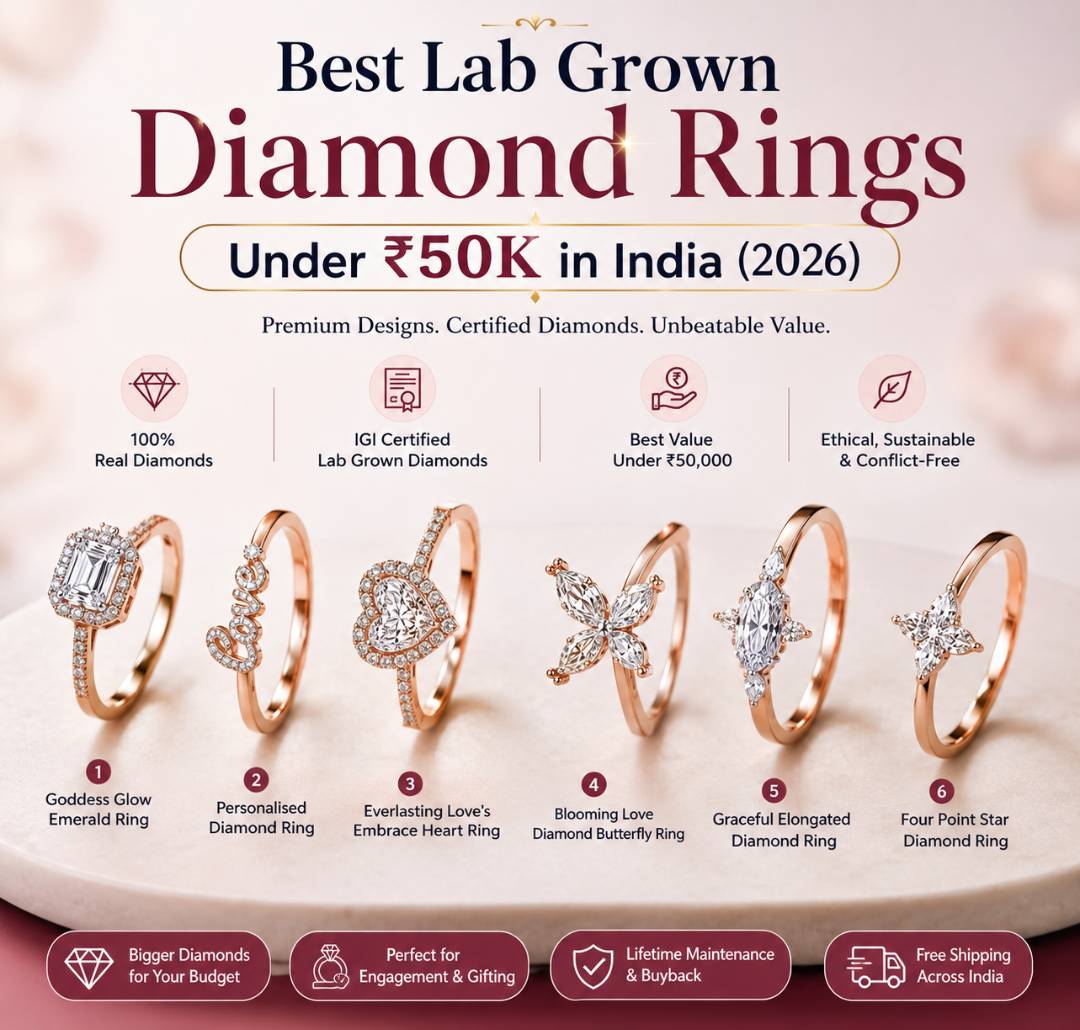
Yes and in 2026, a lab diamond ring under 50000 is a genuinely good ring, not a compromise.
What quality to expect: At this budget, expect a 1 carat stone in the SI clarity, G–H colour range with a very good cut, set in a lighter 14K or 18K gold band. To the naked eye, this diamond will look white, bright, and clean. Alternatively, you can get a 0.70–0.90 carat stone in higher VS clarity visually, the size difference from a full carat is smaller than most buyers expect.
Best settings within budget: A classic 4-prong or 6-prong solitaire setting maximises your diamond budget. Minimal gold, maximum stone.
Solitaire vs halo: A halo setting surrounds the centre stone with small diamonds, making it appear larger. Under ₹50,000, a halo with a 0.50–0.70 carat centre can look bigger than a plain 1 carat solitaire. Choose solitaire for timelessness, halo for visual size.
Realistic expectations: You will not get DEF colour and VVS clarity with a heavy designer setting at this price. But you will get a real, certified diamond that sparkles beautifully something impossible at this budget with a natural stone, where ₹50,000 buys barely 0.20 carats.
Best 1 Carat Lab Grown Diamond Engagement Rings for Different Budgets
The lab grown diamond engagement ring price you should target depends on your priorities. Here is how to allocate smartly at each level.
Under ₹50,000
Best for: First-time buyers and practical couples.
Recommended pick: A 1 carat round brilliant, SI1–SI2 clarity, G–H colour, in a simple 14K gold solitaire setting. Or a 0.80 carat VS stone if eye-clean quality matters more to you than the "1 carat" label.
Tip: Round diamonds hide colour and inclusions better than emerald or asscher cuts at this grade.
₹50,000 – ₹80,000
Best for: Buyers who want the classic engagement ring without compromise.
Recommended pick: A 1 carat round or oval, VS1–VS2 clarity, F–G colour, excellent cut, in an 18K gold solitaire or slim halo. This is the sweet spot of the Indian market — visibly flawless to the eye, certified, and beautifully made.
Tip: Oval cuts appear 10–15% larger than rounds of the same carat weight.
₹80,000+
Best for: Buyers who want top grades and designer craftsmanship.
Recommended pick: A 1 carat (or larger) DEF colour, VVS clarity, ideal cut stone in a detailed 18K gold or platinum setting — pavé bands, hidden halos, or three-stone designs.
Tip: At this budget, consider moving up to 1.25–1.50 carats in VS clarity instead of paying for VVS+ grades the eye cannot detect.
Diamond Ring Price Comparison India – Online vs Offline Jewellery Stores
Where you buy affects the price as much as what you buy. Here is the honest diamond ring price comparison India shoppers should see.
Online jewellery brands
- Pros: Lower overheads mean lower prices for identical certified quality. Wider selection, transparent grading details, home delivery, and usually clear return policies.
- Cons: You cannot try the ring before buying. You depend on photos, videos, and certificates. Stick to brands that offer certified stones and a written return/exchange policy.
Traditional jewellery stores
- Pros: You can see and try the ring physically. Established family trust. Easier in-person exchanges.
- Cons: Showroom rent, staff, and inventory costs are built into the price — often 30–50% higher for the same certified grade. Many traditional stores also carry limited lab grown inventory and may discourage it because margins on natural diamonds are higher.
Direct manufacturers
- Pros: The best pricing in the market, because no middle layer exists between production and your purchase. Brands like The6C work on this model IGI-certified stones at prices closer to manufacturing cost.
- Cons: Fewer physical touchpoints. Verify certification and policies before buying, exactly as you would anywhere else.
The practical rule: compare the certificate, not the showroom. An IGI-certified G colour, VS2, excellent cut diamond is the same diamond whether it sits in a mall showroom or arrives in a courier box. Pay for the stone, not the marble flooring.
Common Mistakes Buyers Make When Comparing Diamond Ring Prices
Avoid these five errors and you will already be ahead of most buyers:
- Comparing only carat weight. "1 carat for ₹45,000" and "1 carat for ₹95,000" are not the same product. Always compare all 4Cs side by side.
- Ignoring certification. An uncertified diamond that costs ₹10,000 less is not a discount — it is an unknown. Buy IGI or GIA certified, always.
- Overpaying for colour grades. The difference between D and G colour is invisible on a finger but costs thousands. G–H is the smart buyer's zone.
- Choosing poor cut quality. A cheap price often hides a shallow or deep cut that kills sparkle. Never go below "Very Good"; aim for "Excellent" or "Ideal."
- Not reviewing return policies. Before paying, confirm the return window, exchange terms, and buyback policy in writing. A trustworthy seller makes these easy to find.
Is a 1 Carat Lab Grown Diamond Ring Worth Buying in 2026?
Direct answer: yes for most Indian buyers, it is the smartest diamond purchase available right now.
Value for money. You get a certified, genuine diamond at 70–80% less than its mined equivalent. No other choice in fine jewellery offers this gap between perceived value and actual cost.
Visual appearance. Identical to natural diamonds in every way the human eye can detect. Same sparkle, same hardness, same lifetime of wear.
Market maturity. Prices in 2026 have largely stabilised after the sharp drops of earlier years. IGI certification is standard, quality is consistent, and major Indian brands now openly sell lab grown collections. The early-adopter risk is gone.
Best buyer profiles: engagement ring couples who would rather put the savings toward their wedding or home, first-time diamond buyers who want certified quality without a ₹2 lakh entry price, and anyone upgrading to a bigger, brighter stone within the same budget.
Who should think twice: buyers purchasing primarily as a financial investment or family heirloom for resale value. For that specific goal, gold remains the traditional Indian choice.
FAQs
What is the price of a 1 carat lab grown diamond ring in India?
In 2026, a 1 carat lab grown diamond ring in India costs between ₹40,000 and ₹1,20,000. A certified, well crafted solitaire in 18K gold typically falls in the ₹50,000–₹90,000 range, depending on cut, colour, and clarity.
Is a lab-grown diamond a real diamond?
Yes. A lab grown diamond is chemically, physically, and optically identical to a mined diamond. It is pure crystallised carbon with a hardness of 10 on the Mohs scale, and it is graded by the same institutes (IGI, GIA) using the same 4Cs.
Can I get a 1 carat lab diamond ring under ₹50,000?
Yes. Under ₹50,000, expect a 1 carat SI clarity, G–H colour stone in a simple gold setting — or a slightly smaller VS clarity stone. Both look clean and brilliant to the naked eye.
Does IGI certification matter for lab grown diamonds?
Yes, strongly. IGI certification independently verifies the diamond's cut, colour, clarity, and carat weight, and confirms it is a genuine lab grown diamond. Never buy an uncertified diamond at any price.
How much cheaper are lab grown diamonds than natural diamonds?
Lab grown diamonds cost roughly 70–80% less than natural diamonds of the same quality. A 1 carat natural diamond ring costing ₹2.5–3 lakh has a lab grown equivalent at ₹50,000–₹80,000.
Which diamond shape looks the biggest?
Oval, pear, and marquise shapes appear larger than a round diamond of the same carat weight because more of their surface area faces up. An oval can look 10–15% bigger than a round of identical weight.
Is a 1 carat diamond a good size for an engagement ring?
Yes. One carat is the most popular engagement ring size in India large enough to be a clear statement, balanced enough for daily wear on most hand sizes.
Do lab grown diamonds fade, turn yellow, or lose sparkle over time?
No. A lab grown diamond is permanent crystallised carbon. It will not fade, cloud, or change colour ever. It needs only the same occasional cleaning as any diamond.
Where should I buy a lab grown diamond ring in India?
Buy from a seller that provides IGI or GIA certification, transparent 4C details, and a clear written return policy. Direct-to-consumer brands like The6C typically offer the best prices because there is no retail middleman markup.
Is it better to buy a lab grown diamond ring online or in a store?
Online and direct-manufacturer prices are usually 30–50% lower for identical certified quality. If you buy online, verify the IGI certificate number on the institute's website before payment.
Final Verdict
If you want a 1 carat diamond ring in India in 2026, the lab grown route gives you the same diamond same carbon, same sparkle, same certification at a fraction of the price of a mined stone.
The smart buying formula is simple: IGI certified, Excellent cut, G–H colour, VS–SI clarity, from a direct or online brand with a clear return policy. Budget ₹50,000–₹90,000 for the classic certified solitaire, less if you are flexible on clarity, more if you want top grades and designer settings.
Lab grown diamonds make the most sense for engagement couples, first-time buyers, and anyone who believes the money saved belongs in their future not in a jeweller's markup.
If you're looking for a certified 1 carat lab-grown diamond ring without paying traditional jewellery markups, explore The6C's latest collection.