
Lab Grown Diamond vs Mined Diamond: The 2026 Buyer's Guide (What I Wish I'd Known Earlier)
Last year, I almost spent ₹3 lakhs on a natural diamond.
It was for an engagement ring. The stone was beautiful—a classic round brilliant, VS1 clarity, good colour. The jeweller presented it with that certain confidence, explaining the '4 Cs', the 'rarity', the 'investment value'. I was ready to sign the cheque.
Then my sister asked one simple question: 'Have you seen what a lab-grown diamond looks like?'
That one question sent me down a rabbit hole on lab grown diamond vs mined diamond and what I found changed everything.
I hadn't. What followed was six weeks of research, comparisons, conversations with gemologists, and some uncomfortable truths about diamonds I'd never questioned. And honestly? If I'd found this guide back then, it would have saved me thousands and months of confusion.
So here's what I'm going to do: Share everything I learned. Not the sales pitch version you get at jewellers. The real story.
Why the Lab Grown Diamond vs Mined Diamond Debate Feels So Confusing (And Why That's Intentional)
If you feel confused about lab vs. natural diamonds, you're not alone. And here's the thing: part of that confusion is by design.
For decades, natural diamonds have been positioned as the 'only real choice.' Marketing campaigns told us they're rare, timeless, valuable. And they are. But what got left out was inconvenient: that 80% of diamonds sold globally come from just a handful of companies, that lab diamonds have existed since the 1950s, and that even GIA and IGI—the world's most respected gemological institutes—now grade lab diamonds using the exact same standards.
The other part of the confusion? Genuine uncertainty. When you're spending lakhs on something you don't fully understand, it's natural to feel anxious. You worry: Are lab diamonds fake? Will they lose value? Can anyone tell the difference? Will my family judge me?
These aren't silly concerns. They're legitimate questions. Let's answer them properly.
First, the Science: Lab Diamond vs Natural and What Are They, Really?
Natural (Mined) Diamonds
Formed 1–3 billion years ago, roughly 100 miles beneath the Earth's surface. Extreme pressure, extreme heat, time. Eventually, volcanic activity forces these diamonds closer to the surface, where modern mining operations extract them.
They're finite. You can only find what nature already made. This scarcity is part of their appeal—and part of why they're expensive.
Lab-Grown Diamonds
Created in a laboratory in 7–10 weeks... Even a gemologist with 30 years of experience can't tell them apart with the naked eye. Only specialized equipment can detect microscopic differences in how they were created.
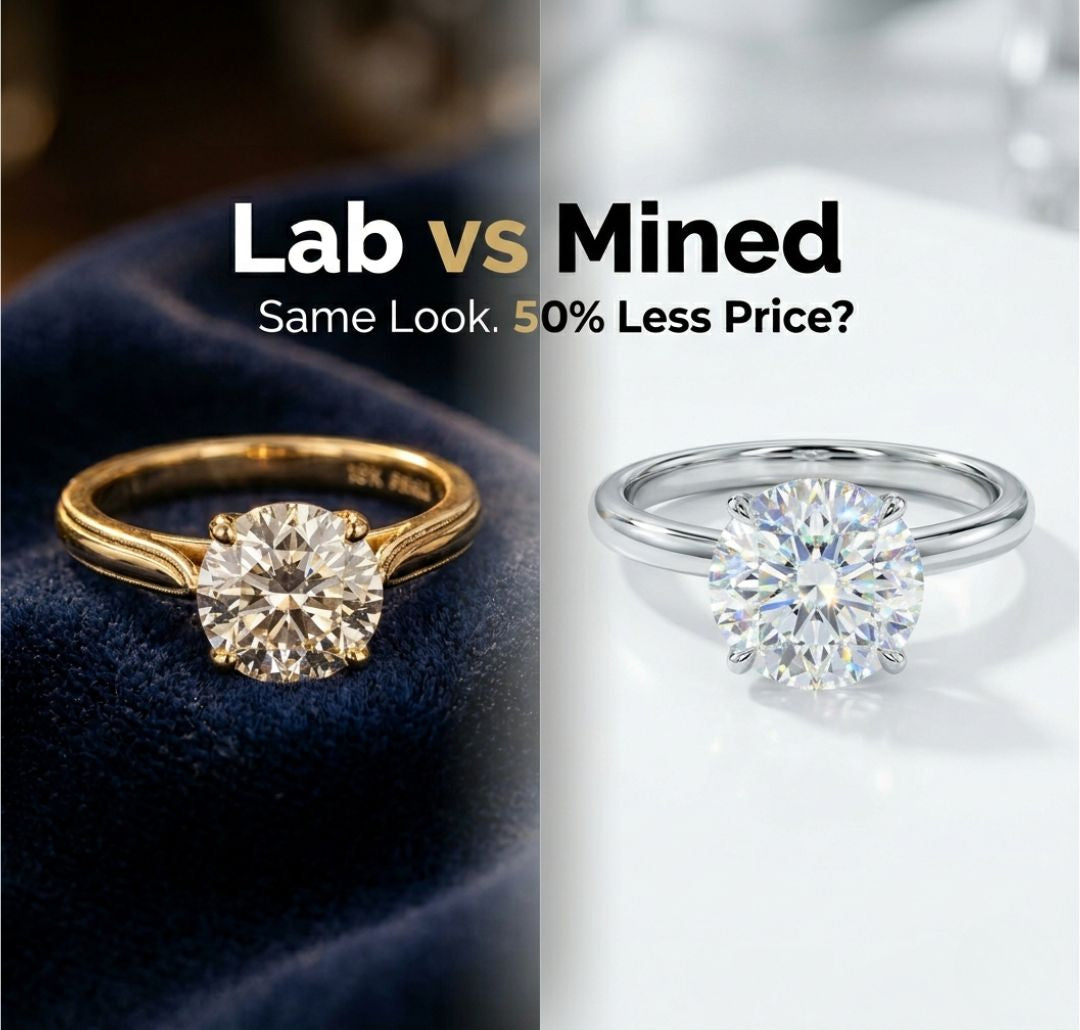
When you compare lab diamonds vs real diamonds side by side, the science is identical same atomic structure, same hardness, same brilliance. The only difference is origin.
And here's what might surprise you: GIA and IGI grade lab-grown diamonds on the exact same 4Cs scale (Carat, Colour, Clarity, Cut) as mined diamonds.
Myth-Busting: 5 Things Jewellers Don't Want You to Know
Myth 1: Lab Diamonds Are 'Fake' or 'Synthetic'
False. This word choice is actually a marketing decision. 'Lab-grown' and 'lab-created' are the correct terms. The word 'synthetic' gets weaponized because it sounds artificial. But synthetically made doesn't mean fake. Insulin is synthetically made. That doesn't make it fake or less effective than naturally derived insulin.
A lab diamond is a real diamond. It has a GIA certificate. It's registered with the same gemological bodies as mined diamonds. It will pass a diamond tester. It has real value. But the framing as 'synthetic' creates perception of inferiority—which is a marketing choice, not a scientific one.
Myth 2: Lab Diamonds Lose Value Quickly
Partially true, but with context. Mined diamonds hold 25–45% resale value. Lab diamonds hold 10–25% resale value. On the surface, that looks bad.
But here's the catch: you didn't buy the diamond to resell it. 93% of diamond jewellery is never sold. It's kept, passed down, repurposed into new designs. The resale value metric matters only if you're treating a diamond as an investment—which isn't why most people buy them.
Plus—and this is crucial—the resale gap exists today because lab diamonds are newer to the market. As they become more mainstream (and they are, rapidly), resale value will likely improve. But for the person wearing the ring? This shouldn't drive your decision.
Myth 3: Everyone Can Tell It's a Lab Diamond
False. Not even trained gemologists can tell the difference without specialized equipment. A loupe won't do it. A regular jeweller's tools won't do it. Only specific lab equipment—FTIR spectrometers, photoluminescence testing—can detect the microscopic indicators of lab creation.
Your mother-in-law? Your colleagues? Your best friend? They won't know. The diamond will look identical, sparkle identically, and perform identically. The only people who know are the ones who look at the certification. And you control who you tell.
Myth 4: Mined Diamonds Are Always Better Quality
False. In fact, the opposite is often true. Lab diamonds are grown in controlled conditions, which means fewer inclusions and colour inconsistencies at the same price point. You can often get a VS1 clarity lab diamond for the price of an SI1 mined diamond.
Quality is determined by the 4Cs, not by origin. A D-colour, VVS1 clarity, excellent cut lab diamond is objectively more beautiful and durable than a D-colour, SI1 clarity, good cut mined diamond. Period.
Myth 5: Lab Diamonds Are a New, Untested Technology
False. Lab diamonds have existed since the 1950s. We're not talking about something untested. We're talking about technology that's been around for 70 years, heavily researched, and certified by the world's most respected gemological institutes. GIA started certifying lab diamonds in 2007. IGI has been doing it even longer. These aren't amateurs.
Lab Grown Diamond vs Mined Diamond: The Complete Comparison Breakdown
|
Factor |
Lab-Grown |
Mined |
|
Price (1 carat) |
₹50,000–80,000 |
₹1,50,000–3,00,000+ |
|
Origin |
Lab (7–10 weeks) |
Earth (1–3 billion years) |
|
Quality (4Cs) |
Identical grading |
Identical grading |
|
Durability |
Mohs 10 (forever) |
Mohs 10 (forever) |
|
Certification |
GIA, IGI (yes) |
GIA, IGI (yes) |
|
Resale Value |
10–25% of cost |
25–45% of cost |
|
Environmental Impact |
Very low carbon |
127 tonnes CO2/carat |
|
Ethical Concerns |
None (lab-controlled) |
Mining/labour concerns |
|
Availability |
On-demand |
Finite supply |

Price: Why the Difference, and What It Means for You
A 1-carat lab-grown diamond, VS1 clarity, G colour, excellent cut: ₹50,000–80,000
The same specs in a mined diamond: ₹1,50,000–3,00,000+
This isn't a 10% difference. This is a 3–6x difference. And when you look at lab grown diamonds vs real mined stones on price alone, the math is hard to ignore — you're often getting 2–3x the size for the same budget. Let's talk about why, and what it means.
Mined diamonds are expensive because:
(1) They're rare—finite supply formed over billions of years.
(2) Mining is expensive—large-scale operations, environmental regulations, labour costs.
(3) Marketing is expensive—billions spent positioning diamonds as the only 'real' choice for engagement.
Lab diamonds are cheaper because:
(1) They can be made on demand—no scarcity.
(2) Production scales—a lab can grow multiple diamonds simultaneously.
(3) No mining costs—no large-scale land disruption, no environmental remediation.
Here's what this means for your wallet: For ₹2 lakhs, you can buy a 0.7-carat mined diamond, or a 2-carat lab diamond. Same carat total weight, same quality, completely different experience. One lets you showcase a stunning, larger stone. The other lets you brag about rarity (that's quickly shrinking).
2026 Trends: What's Actually Happening in India
Lab-grown diamonds are not a trend. They're a shift. This diamond buying guide for India wouldn't be complete without understanding where the market is actually headed. Growth is accelerating: In 2024, lab-grown diamonds made up 9% of the global diamond market. In India, adoption is faster. Delhi, Mumbai, Bengaluru, Pune—metro buyers are switching in droves. Especially millennials and Gen Z.
Younger buyers are redefining luxury: It's no longer just about owning something rare. It's about owning something that aligns with your values. Ethical sourcing, sustainability, transparency. Lab diamonds tick all these boxes.
Hybrid purchasing is normal now: Many couples buy a mined diamond as a heritage piece (a pendant, brooch) and a lab-grown engagement ring. The best of tradition and modernity.
Certification matters more than origin: In 2026, buyers care less about whether a diamond came from the ground or a lab, and more about whether it comes with proper GIA/IGI certification, full transparency, and a reputable brand behind it.
High-street jewellers are shifting: Even traditional jewellers who built their reputation on mined diamonds are adding lab-grown collections. Because their customers are asking for it.
The Ethics Question: Why Some Buyers Are Making the Switch
If you don't care about the ethics of diamond sourcing, skip this section. But if you do—and an increasing number of Indian buyers do—this matters.
Mining for natural diamonds involves: Large-scale land disruption. Significant carbon emissions (estimated 127 tonnes of CO2 per carat). Potential for conflict diamonds (though Kimberley Process attempts to prevent this). Labour concerns in certain regions.
Lab-grown diamonds involve: Controlled lab environments. Minimal land impact. Lower carbon footprint (roughly 1/3 that of mined diamonds). Fully traceable supply chain. No conflict sourcing possible.
This isn't about judging people who buy mined diamonds. It's about giving you the information to make a choice aligned with your values.
Our Opinion: Who Should Buy Which (Clear Guidance)
Choose Lab-Grown If:
• You want maximum value for your money—a larger, cleaner stone at half the price.
• You care about ethics and sustainability in your purchases.
• You're buying an engagement ring or everyday piece you'll actually wear.
• You value transparency and want full certification with your diamond.
• You're not planning to resell—you want to keep it forever.
Choose Mined If:
• You specifically want a billion-year-old stone—the romantic story matters to you.
• You're buying a heirloom piece that will be passed down for generations.
• You have the budget for premium quality and don't mind the higher cost.
• You anticipate possibly reselling years down the line.
• Your family tradition demands mined stones.
Our honest take: For 95% of Indian diamond buyers in 2026, lab-grown is the smarter choice. Better value, better ethics, better quality at that price point. Mined diamonds still have their place—but it's shrinking.
Why This Matters: Making Your Decision
Here's what I've learned: the best diamond is the one that aligns with three things: your budget, your values, and the story you want to tell.
At The6C, we specialize in certified lab-grown diamonds—and we're transparent about everything. Every diamond comes with a GIA or IGI certificate. Full 4Cs grading. Ethical sourcing documentation. And a real person behind your purchase who can answer your questions honestly.
We don't push you toward one choice. We give you the facts, answer your questions, and let you decide what's right for you.
FAQ: Your Questions Answered
Q1: Are lab diamonds certified?
Yes. Every lab diamond should come with a GIA or IGI certificate—the same certification bodies that certify mined diamonds. Your certificate includes carat, colour, clarity, cut, dimensions, and polish. No lab diamond from a reputable source should come without this.
Q2: Will my lab diamond yellow or fade over time?
No. Lab and mined diamonds are chemically identical. They age identically. A D-colour lab diamond will remain D-colour for eternity. There's no degradation, no yellowing, no fade. You could pass it to your great-grandchildren and it will look the same.
Q3: Can my jeweller set a lab diamond?
Absolutely. A lab diamond is a real diamond. Any jeweller who can set a mined diamond can set a lab diamond. It's the same process, same materials. In fact, many high-street jewellers are now offering lab diamonds in their own designs.
Q4: What if I want to resell or exchange my lab diamond?
Most reputable jewellers offer buyback and exchange policies. The6C, for example, offers 100% buyback on certified diamonds. Resale value is lower than mined diamonds, but improving as market adoption grows. For most buyers, this shouldn't be the deciding factor.
Q5: Which celebrities/brands are using lab diamonds?
More than you'd think. Brands like Tiffany, De Beers (surprisingly), and countless celebrity designers are now using lab diamonds. The shift is real. What's not talked about openly is how many high-end brands have always used them—they just don't advertise it.
Quick Answer (Featured Snippet)
When comparing lab grown diamond vs mined diamond, the key difference is origin and cost: lab-grown diamonds are real diamonds created in laboratories in 7–10 weeks using controlled temperature and pressure, while mined diamonds form naturally over 1–3 billion years underground.
Lab diamonds cost 50–70% less than mined diamonds of identical quality but hold less resale value (10–25% vs 25–45%). Both are certified by GIA and IGI using the same 4Cs grading system. Lab diamonds are more ethical and sustainable; mined diamonds carry historical and emotional value. For most Indian buyers in 2026, lab-grown diamonds offer better value, quality, and alignment with modern values.