
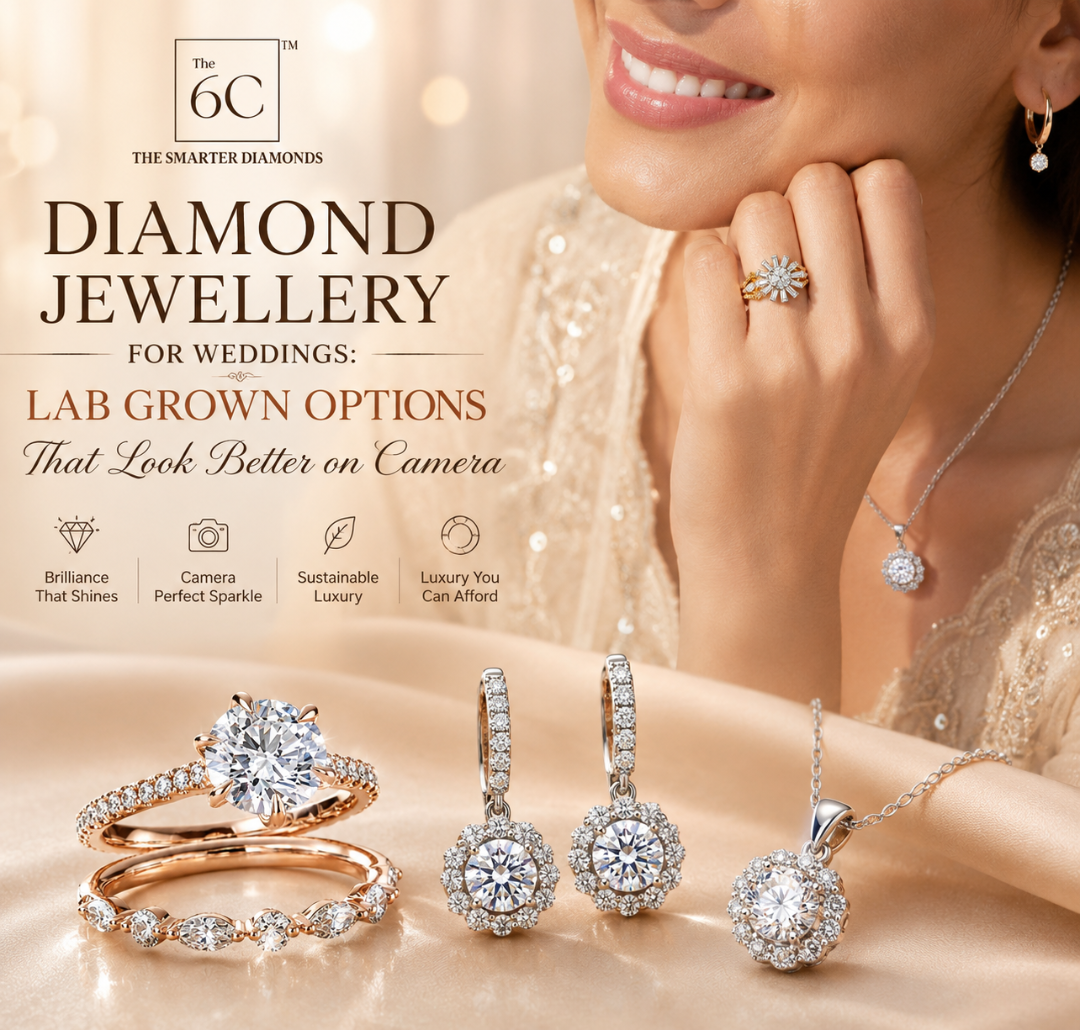
Diamond Jewellery for Weddings: Lab Grown Options That Look Better on Camera
The New Cinematic Standard of Indian Weddings
By the time you reach the mandap, you've already been filmed for six hours.
That's the part no one prepares you for. The lehenga gets months. The skin gets a regimen. The jewellery gets... whatever Mummy and the family jeweller decided three generations ago. And then the footage comes back a 4K reel, a gimbal-shot slow-motion sequence, a drone pull-back over the shamiana and the gold glows beautifully while the stones do absolutely nothing. Flat. Dark. Reading as weight rather than light.
Here's the uncomfortable truth I tell every client: a modern Indian wedding is a film production, and your jewellery has a speaking role. It either performs on camera or it disappears.
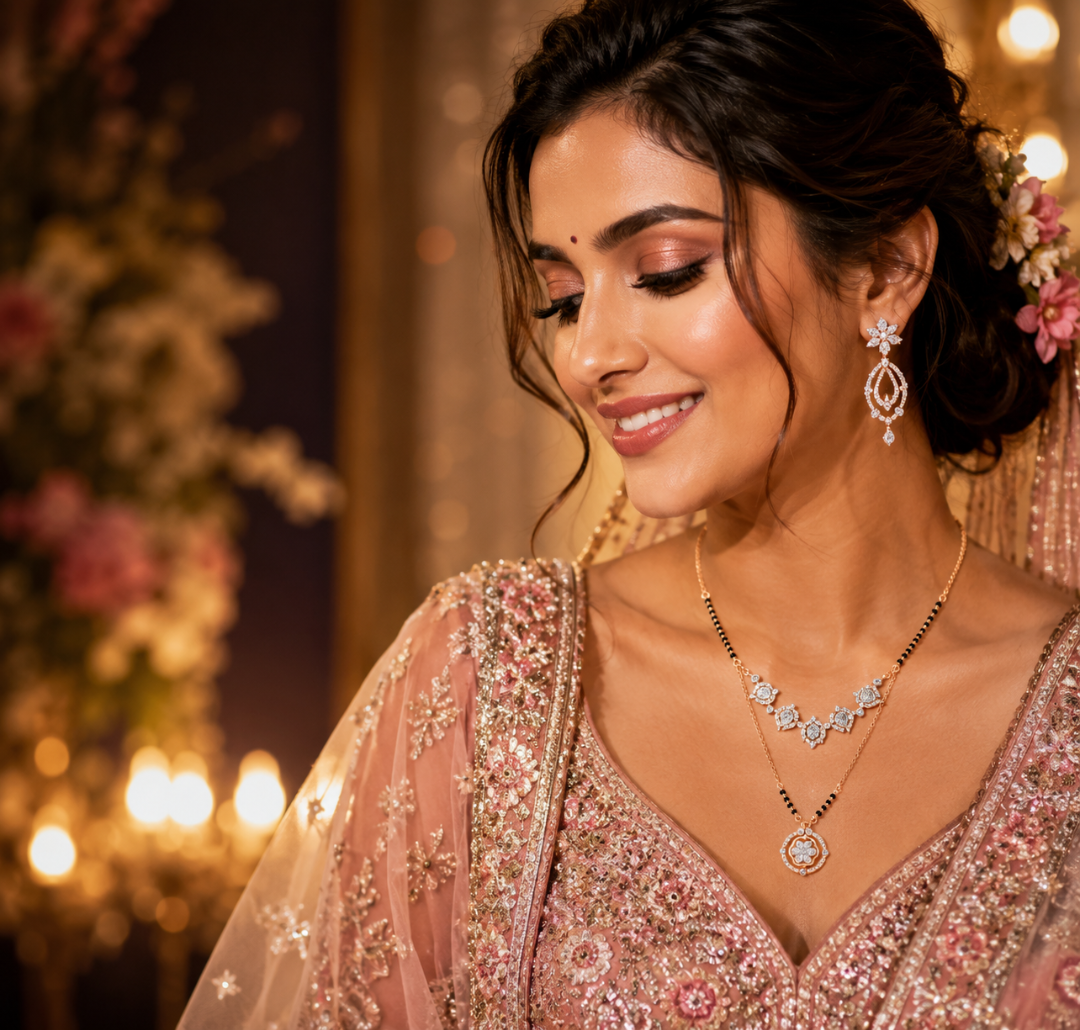
Most traditional heavy sets are built for the mirror, not the lens. Under the fast-switching light of a live wedding golden tungsten at the pheras, a photographer's cold flash at the reception, saturated colour washing off an LED wall opaque, light-absorbing pieces sink into the frame. They don't fail in person. They fail in the edit, where you'll actually be living for the next forty years.
So the question every serious bride is now asking has changed. It's no longer what looks regal in the showroom. It's what holds up at f/2.8 from six inches away. The answer keeps landing on the same material: the diamond and increasingly, the lab-grown diamond, chosen by couples who want the optics, the scale, and a clear conscience all at once. What follows is how to choose diamond jewellery for weddings that actively works for the camera instead of fighting it.
The Physics of Sparkle: Why Diamonds Dominate the Lens
Everything starts with one number: 2.42.
That's a diamond's refractive index, among the highest of any clear material on earth. It means the stone grabs incoming light, slows it hard, splits it into its spectral colours, and throws it back out. Photographers have names for the result "fire" for the rainbow flashes, "brilliance" for the white ones. A high-resolution sensor reads both as crisp pin-bursts of light. That's the texture that makes a frame feel expensive.
Now hold that against what's traditionally filled the Indian trousseau. Polki and kundan hold the room soft, milky and regal. But they work by reflecting off a flat surface, not refracting through angled facets. Meenakari enamel and most coloured stones are opaque or low in dispersion; they drink light instead of returning it. In person, lovely. On a sensor, under unpredictable light, the gap between radiant and muted opens up fast.
Three things are happening through the lens:
-
Dispersion at scale. A 58-facet round brilliant behaves like dozens of tiny angled mirrors firing in different directions at once. As you laugh, turn, lift a hand, the facets fire in sequence — that's the shimmer videographers slow down to 120 frames a second to catch.
-
Edge integrity in HD. Precision cutting keeps facet junctions razor-sharp, so on a macro shot the stone holds defined edges instead of blurring into a soft grey blob.
-
Colour-temperature independence. Real weddings swing from warm tungsten near 3200K to outdoor sun around 5600K. A diamond performs across both because it isn't borrowing its colour from the room — it's splitting whatever light arrives, warm or cold.
Which is the whole point: a diamond doesn't need the lighting to flatter it. It makes its own light show.
The Lab Grown Shift in Indian Bridal Trousseaus
Let's be honest about the wedding budget, because everyone dances around it.
Freeing up capital on the stone is the single highest-leverage decision a couple makes. Choose lab-grown, and the same spend that bought a modest mined set now buys genuine scale without dropping to lower colour grades or settling for visible inclusions to hit the number. That's not a compromise. That's a smarter allocation, and the generation getting married now has done the math.
These couples also did the reading. They know a lab-grown diamond isn't an imitation it's chemically and optically a diamond, hardness 10, refractive index 2.42, grown in a controlled chamber rather than over a billion years of geology. They've watched their parents pay a scarcity premium for provenance no one could verify. They've decided they'd rather put that money into the design.
The quality ceiling surprises most of them. The finest lab-grown stones including those The6C works with are Type IIa: the purest classification of diamond, less than 2% of all mined stones, the same class as the Koh-i-Noor. And here's why that's not just a flex on camera. Type IIa diamonds carry essentially no nitrogen impurities. Nitrogen is what absorbs specific light wavelengths and pulls a stone slightly warm or muddy. Strip it out, and you get a crisp, icy, neutral white that holds its colour even under heavy, saturated stage light which leads directly into the problem nobody warns you about.
The warm-LED-stage nightmare
Walk into almost any modern Indian reception and you'll find a wall of LED screens behind the stage and warm spotlights raking across the couple. Beautiful for the guests. Brutal for traditional jewellery.
Those saturated colour washes and screen reflections throw cast shadows and colour spill onto the neck and chest. Pieces that depend on the ambient light for their look pick up that muddy colour and the bride's décolletage goes grey-green in the footage. Type IIa lab-grown diamonds don't play that game with no nitrogen to absorb and re-tint the light, they hold a neutral icy sparkle even when the whole stage is bathed in magenta and amber. The stone stays the stone, regardless of what the AV team is doing behind you.
On the practical side, the budget rebalances toward things the camera actually rewards: larger carats that fill a wide-angle frame, VVS1–VS1 clarity that survives a macro lens, and D–F colour that photographs as pure white instead of faint yellow.
When mapping out a contemporary bridal look, modern brides are increasingly exploring lab-grown diamond jewellery trends in India for more stylish, eco-conscious, and practical wedding choices that don't compromise on scale or brilliance.
The 4K Camera Test: Pieces, Framed by the Moments You'll Actually Wear Them In
Forget the generic checklist of necklaces, earrings, rings. Every piece lives inside a specific situation, a specific lens, a specific ritual. Here's how the real ones perform.
The 3-carat rule for the Jaimala close-up
The jaimala exchange is shot tight and from the front the most face-forward frame of the entire wedding. Your choker is in that shot whether you planned for it or not. The mistake brides make is density: a choker over-layered with a long haar reads as one solid clotted mass on a wide-angle lens, and it visually amputates the neck.
Leave deliberate air between layers. One clean choker with a single graduated piece below it elongates the line and lets each catch its own light. And size the centre of the choker generously a stone that feels almost loud in the mirror reads as correct once the lens flattens and shrinks it. That's the rule: scale up, space out.
Why round brilliants compete with a heavy lehenga and step-cuts win
Here's a real conflict almost no blog addresses. A heavy bridal lehenga is a field of metallic zari and zardozi, and all that thread reflects light back up onto your jewellery. Put a round brilliant choker against that, and the stone's busy, scattered sparkle visually competes with the glitter of the fabric two noisy textures fighting in the same frame. The camera doesn't know where to rest.
The move is contrasted through structure. Emerald and Asscher cuts step-cuts, with long sleek mirror-like facets give a calm, architectural flash instead of scattered twinkle. Against a busy embroidered surface, that clean linear light reads as deliberate and high-fashion. The fabric does the sparkle; the jewellery does the structure. They stop fighting.
Chandelier earrings and the Vidaai car
Earrings earn their keep in profile, and the most devastating profile shot of the wedding happens in the worst lighting of the wedding: the Vidaai, when you're inside the car, the door's still open, and there's one weak interior bulb doing all the work.
That's where long, articulated chandelier earrings save the frame. Multiple hinged sections mean movement, and movement catches the smallest available light even a single dim car bulb and turns it into a flash beside your face exactly as you turn back to look at your family. A rigid single drop just sits there in the dark. Choose hinges. Choose movement.
The cocktail ring, the Ring Ceremony, and Sindoor Khela
The ring is the macro star, and Indian rituals hand it the perfect stage. The hand entering the frame during the Ring Ceremony. The downward press of sindoor. Mehendi-laden fingers cradling the dupatta. These are shot inches from the lens, and a bold cocktail ring becomes the entire composition.
Go big and go wide here. A broad, low, faceted stone returns more light to a macro sensor than a tall narrow one, and the macro lens will shrink it anyway. The ring you think is too much is usually the ring that's exactly enough.
Reception suites and the pre-wedding shoot
Two ends of one spectrum. Reception lighting is moody, dark, spotlit, and flash-heavy which is paradise for a bold, high-reflectivity diamond suite, because the surrounding darkness makes every flash read as theatre. Save your loudest set for here.
The pre-wedding shoot is the opposite: candid, fluid, golden hour, motion. Heavy bridal sets look staged in that context. A slim tennis bracelet, fine solitaire studs, a delicate diamond line these catch the low sun and keep the focus on the couple, not the carats.
The Bridal Photographer's Guide to Styling Diamond Jewellery
Sit with a destination wedding photographer for ten minutes and they'll tell you the whole game is light management. A few rules they live by.
Day fights you with overexposure; night fights you with dead spots. Harsh midday sun blows highlights into white blobs with no facet detail, so for daytime ceremonies, more intricately faceted or slightly smaller pieces hold their definition. Dark receptions do the reverse: a stone caught in shadow simply vanishes so there, bigger and bolder is what survives.
Match diamonds to the lehenga by contrast, not by matching.
-
Deep classic red plus white diamonds is the highest-contrast, most reliably photogenic pairing in the Indian canon. Keep the stones white and bold; don't muddy them with competing coloured gems.
-
Pastels sage, blush, powder blue go flat on camera without a sharp glint, and diamonds supply exactly that edge.
-
Ivory, champagne, metallic drapes are the contemporary couture picks, but they're low-contrast against white stones, so scale up or the jewellery melts into the fabric.
The layering boundary is physical, not just visual. Pieces packed too close don't only look cluttered, they rub, and on camera they throw overlapping shadows that no edit fully rescues. Give each piece its own pool of light.
One cue worth memorising: pair an emerald-cut choker with a square or boat neckline. The straight steps of the cut echo the straight line of the neck, and the lens reads the whole thing as architectural and intentional.
Redefining Bridal Legacy with The6C
The6C was built for the bride caught between two wants: her grandmother's grandeur and her own generation's conscience.
The house refuses the idea that lab-grown is the budget shelf. It works in premium Type IIa diamonds and pairs them with cutting calibrated for light return that 45° optimization isn't marketing, it's the difference between a stone that performs in candid frames and one that only behaves under a spotlight. The craftsmanship is artisanal; the design language reads 2026, not a reissued heirloom template. And because the diamonds are grown rather than mined, the scale and the icy brilliance arrive without the ethical and financial freight.
That's the actual bridge a modern bride wants: Indian wedding heritage, re-engineered as sustainable luxury light-catching, line-elongating, and built to hold its colour from the baraat to the last reception frame.
Frequently Asked Questions
Do lab-grown diamonds look good in wedding photos?
Yes, often better than the alternatives. They're optically identical to mined diamonds, carrying the same 2.42 refractive index that produces fire and brilliance on camera. Because lab-grown stones come in higher clarity (VVS–VS) and colour (D–F) grades for the price, they read as exceptionally clean and bright in HD and 4K footage.
Which diamond cut sparkles most on camera under warm wedding lights?
The round fires most consistently, since its 58 facets return light from nearly every direction even under uneven 3200K tungsten and stage lighting. For a sleeker, more architectural flash especially against a busy embroidered lehenga — emerald and Asscher step-cuts perform better.
Are lab-grown diamonds real enough for bridal wear and legacy?
They are real diamonds, with identical chemical composition, crystal structure, hardness (10 on the Mohs scale), and optical behaviour to mined stones the only difference is origin. They wear and last identically and pass down as heirlooms just the same.
What jewellery is best for cinematic 4K wedding videography shoots?
Pieces with movement and clean light return. Articulated chandelier earrings, a graduated necklace, and a bold cocktail ring catch and throw light as you move, which slow-motion 4K captures dramatically. High clarity matters more at 4K, since the resolution can expose inclusions that still might hide.
How do I stop my bridal diamond set from reflecting green or purple camera flares?
Off-colour flares usually trace back to poorly cut stones, coatings, or simulants — not high-grade diamonds. Choose colourless, high-clarity Type IIa lab-grown stones, and ask your photographer to angle the key light slightly off-axis so the flash doesn't bounce straight back into the lens.
Can guests or photographers tell the difference between mined and lab-grown diamonds on sight?
No. The two are visually and optically indistinguishable to the naked eye, even to trained jewellers, without laboratory equipment. On camera the difference is zero brilliance, fire, and scintillation read identically.
What is the best diamond clarity grade for a bridal photoshoot?
VVS1 to VS1 is the sweet spot. Inclusions at those grades are invisible to the eye and to wedding photography, including ring and necklace macro close-ups. Lab-grown diamonds make those grades reachable at full bridal scale.
How do I coordinate diamond jewellery with a heavily embroidered red bridal lehenga?
White diamonds against deep red is the highest-contrast bridal pairing there is, so keep the stones white and let them pop. Favour step-cuts emerald, Asscher whose clean lines contrast the busy zardozi rather than round brilliants that compete with the thread-glitter, and keep the neckline relatively open so the choker reads clearly in close-ups.
Are lab-grown diamonds a good choice for a tight wedding budget?
Yes they let you buy meaningfully more diamond for the same money larger carats, higher clarity, better colour than an equivalent mined budget allows. That's how brides reach grand, camera-filling layouts without overspending.
Which jewellery sparkles most on camera overall?
High-clarity, well-cut diamonds, ahead of polki, kundan, and coloured gemstones, because of their superior light dispersion. Prioritise round brilliants, colourless grades, and pieces that move and save your boldest set for the darker reception, where contrast maximises the flash.
A Sparkle That Outlives the Day
The flowers wilt by morning. The guests drive home. What stays is the footage replayed on anniversaries, shown to children not yet born, the permanent record of the day everything changed.
In those frames, you want light. The catch of a diamond as you turn to laugh. The flash beside your face in the dim Vidaai car. The macro glints on a mehendi-stained hand pressing forward during sindoor. You want jewellery that didn't just sit there for the camera jewellery that worked for it.
That's what diamonds engineered for the lens give you, chosen without the ethical weight, scaled without the compromise. Bridal sparkle that's as considered as it is timeless.
When the lookbook's nearly done, walk through the latest bridal diamond trends and 2026 styling directions and see how The6C is rebuilding what a modern Indian bride's diamonds can do.