
Gold vs Platinum vs Silver Settings for Lab-Grown Diamond Jewellery: Which Lasts Longest?
A jeweller's bench-side notes on the metal that actually holds your diamond for life, and the one that quietly fails.
The Question Nobody Asks Until It's Too Late
You spent months choosing the diamond. You researched cut, colour, clarity, carat. You can recite the difference between VVS1 and VS1.
And then the jeweller asks, "Gold, platinum, or silver setting?", and you answer in four seconds based on price, or what your mother wore, or which one looked shinier in the showroom case.
That four-second decision is the one that determines whether your stone is still sitting safely in its prongs in 2046. The metal isn't the frame around the diamond. It's the thing physically gripping a stone you'll wear through dishwashing, gym bags, car doors, and twenty winters of coat sleeves. Choose wrong, and the most common way people lose a lab-grown diamond isn't theft or damage to the stone, it's a worn-down prong that finally lets go while they're washing their hands.
So before you pick by colour or by the number on the tag, here's what's actually happening at the metal level, bench reality, not brochure copy. By the end you'll know which setting metal genuinely lasts longest for a daily-wear diamond ring in India, and why the "obvious" answer and the "right" answer aren't always the same.
The Three Contenders, Honestly Ranked
Let's settle the headline before the nuance, because that's what you came for.
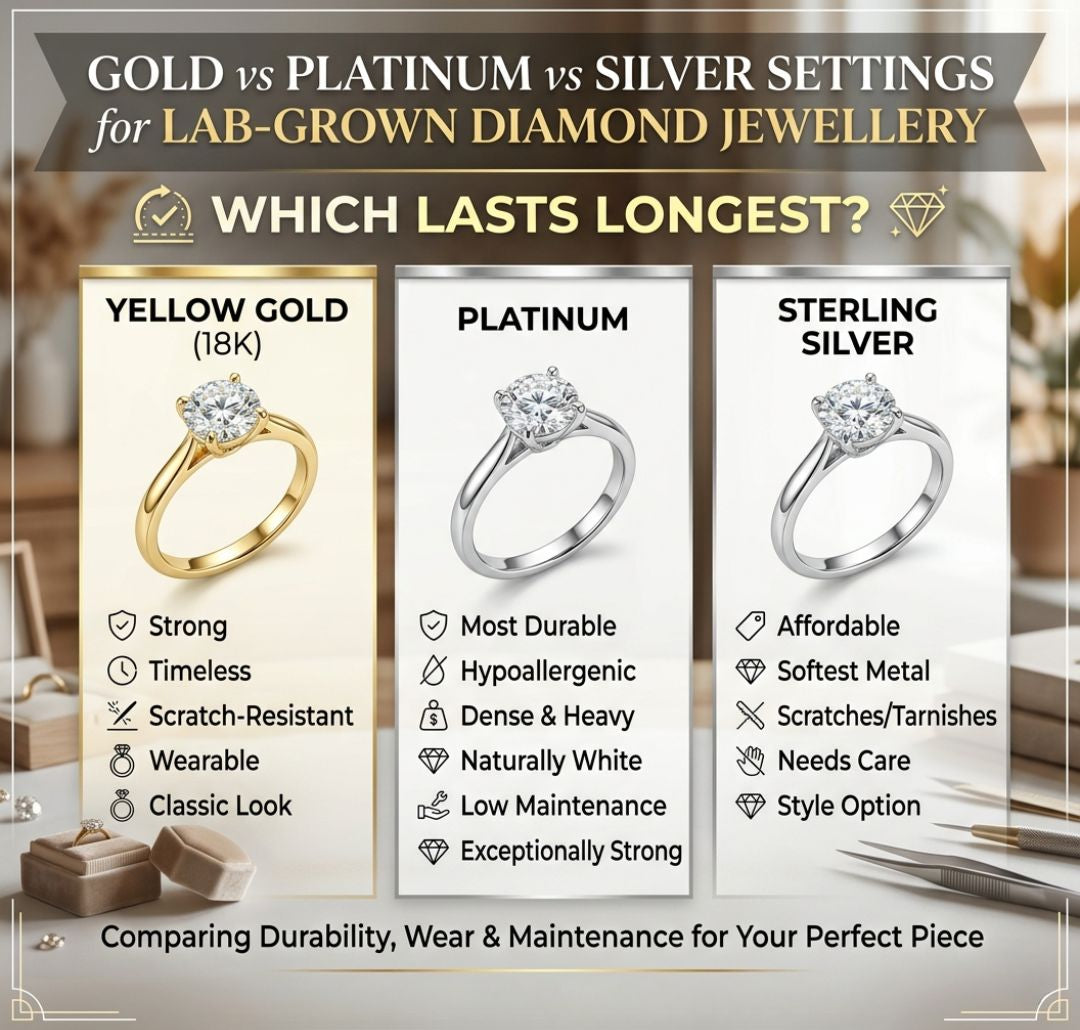
For sheer longevity holding a diamond, the order is: platinum first, gold second, silver a distant third. Silver isn't really in the same conversation for a wedding-grade or heirloom diamond piece, and I'll explain exactly why below. But "platinum wins" is too blunt to be useful, gold beats platinum on several real-world axes, and the right pick depends on how you live, not on which metal is technically hardest.
Here's the bench-level breakdown:
- Platinum: the densest, most secure, most enduring prong metal, but heavy, pricier, and it dulls to a soft grey patina (which some people love and some don't).
- Gold (18kt or 14kt): the practical sweet spot for most Indian buyers, durable enough, repairable anywhere, available in yellow, white, and rose, and easier on the budget.
- Silver: beautiful, affordable, and the wrong choice for a stone you intend to keep, because it's too soft and too reactive for secure long-term setting.
Now the part that actually changes your decision.
Platinum: The Metal That Wears Down Instead of Wearing Away
Here's the counterintuitive thing about platinum that almost no showroom explains properly.
Platinum is not harder than white gold. People assume it is, because it costs more and feels heavier. It isn't. What platinum has is density and a different failure mode. When gold gets scratched or knocked, tiny bits of metal are lost, the prong slowly sheds material over the years until it's thin enough to bend or snap. When platinum gets scratched, the metal isn't lost; it's just displaced, pushed to the side. The same volume of metal stays on your ring, which is why a platinum prong holds its mass for decades while a gold one quietly slims down.
That's the entire longevity argument in one sentence: platinum keeps its metal, gold loses its metal. For the single job of gripping a diamond securely for fifty years, that displacement property is why master jewellers default to platinum for high-value stones.
The patina question is where people get confused. Over months of wear, that constant displacement gives polished platinum a soft, satiny grey finish, the "patina." This isn't damage. The metal is all still there. Some clients adore the vintage, lived-in look; others want the mirror shine back and have it re-polished once a year for a few hundred rupees. Worth knowing before you buy, so the patina doesn't surprise you into thinking your ring is degrading when it's doing exactly what platinum does.
The real trade-offs are honest ones. Platinum is roughly 60% denser than 18kt gold, so it feels noticeably heavier on the hand, lovely to some, a nuisance to others over a full day. It typically carries a higher price per gram, and because it's harder to work, skilled platinum sizing and repair isn't available at every neighbourhood jeweller in India the way gold work is. If you live somewhere without a serious platinum-capable workshop nearby, that's a genuine practical factor.
Gold: Why 18kt Beats 24kt for a Diamond Setting
Start with the fact that surprises people: you do not want pure gold holding your diamond.
24kt gold, the 99.9% pure gold prized for investment and traditional jewellery, is far too soft to be a setting metal. Press your fingernail into pure gold and it marks. A prong made of 24kt would bend out of shape within weeks of daily wear, and your stone would be gone. This is why diamond settings use alloyed gold, and why the karat number matters more than buyers realise.
The numbers, plainly:
- 24kt = 100% gold. Soft. Beautiful for bangles and bullion. Wrong for prongs.
- 22kt = ~91.6% gold. Still on the soft side for fine prong work, though common in traditional Indian settings.
- 18kt = 75% gold, 25% alloy (copper, silver, palladium, etc.). The professional standard for diamond settings, hard enough to hold a stone securely, rich enough to still read as proper gold.
- 14kt = 58.5% gold. Harder and more affordable still, excellent for daily-wear durability, slightly less "gold" in colour and value.
For a lab-grown diamond ring you'll wear every day in India, 18kt is the durability-to-value sweet spot. It's the karat that holds a prong reliably for decades while keeping the warm gold character buyers actually want. 14kt is the more rugged, more economical alternative if your hands take genuine daily punishment.
Then there's colour, which is really a maintenance question in disguise.
White gold isn't naturally white, it's yellow gold alloyed pale and then plated with rhodium for that bright, platinum-like shine. That plating is a coating, and coatings wear. Every couple of years the rhodium thins and a faint warm tone bleeds through, and the ring needs re-plating, a small, cheap job, but a recurring one you should budget for. Yellow gold and rose gold have no plating to wear off; their colour is the metal itself, so they age more gracefully with zero upkeep on that front. This single fact, plating wears, solid colour doesn't, quietly decides a lot of long-term-happiness outcomes that nobody mentions at the point of sale.
White gold vs platinum: the decision most Indian buyers are actually making
This is the real fork in the road for diamond jewellery in India, so let's make it clean.
They look nearly identical on day one, both bright, white, mirror-finished. The differences show up over years:
- Platinum stays white forever because it is white metal all the way through. No plating, no re-coating, ever. It develops patina (re-polish if you want shine back), and it grips the stone with that superior displacement property.
- White gold gives you the same look on day one at a lower price and lighter weight, but it needs periodic rhodium re-plating to stay bright, and its prongs shed metal over time rather than holding mass.
So the honest summary: pick platinum if you want set-it-and-forget-it permanence and don't mind the weight or the cost. Pick white gold if you want the platinum look today at a friendlier price and you're fine with a re-plate every couple of years. Neither is "wrong." They're different relationships with maintenance.
Silver: The Honest Talk
Silver is where I have to be the jeweller who tells you what you don't want to hear.
Sterling silver is genuinely lovely, bright, affordable, and perfect for fashion pieces and everyday costume jewellery. For a lab-grown diamond you intend to keep, it's the wrong setting metal, and not by a small margin.
Two reasons, both physical:
It's too soft. Sterling silver (92.5% silver) is softer than 18kt gold and far softer than platinum. Prongs made of silver bend and wear quickly, which means a real, ongoing risk of the stone loosening and dropping. For an inexpensive stone that's an acceptable gamble. For a diamond you chose carefully, it isn't.
It tarnishes. Silver reacts with sulphur in the air and on skin, which is why silver jewellery goes dark and needs regular polishing. In India's humidity and pollution, that reaction is faster. Constant cleaning is both a hassle and, over time, abrasive to a delicate setting.
There's a place for silver in a jewellery box, just not as the lifetime guardian of a diamond you'd be heartbroken to lose. If budget is the driver, a 14kt gold setting gets you proper durability at a far gentler price than platinum, and that's the smarter economy than silver.
How You Live Decides the Metal: A Quick Self-Diagnosis
Forget the showroom. The right metal is the one that matches your actual hands and habits. Run yourself through this:
- You want a true never-fuss heirloom and don't flinch at weight or price → platinum. It outlasts everything and protects the stone best.
- You want the white look, a friendlier price, and you'll do a re-plate every couple of years → white gold (18kt).
- You love warm tones and zero colour upkeep → yellow or rose gold (18kt), solid colour that never needs re-coating.
- Your hands take a beating, gym, kids, manual work, and you want toughness on a budget → 14kt gold, harder and more economical.
- You want a fashion piece, not a forever piece → silver is fine, with eyes open about tarnish and prong softness.
Notice what's missing from that list: a single universal "best." Anyone who tells you one metal wins for everyone is selling, not advising.
The Lab-Grown Connection: More Stone, So Protect It Right
Here's where the metal choice and the modern diamond choice intersect in a way worth pausing on.
Because lab-grown diamonds let you put a noticeably larger, higher-clarity stone on the hand for the same budget, the value sitting in those prongs is often greater than buyers realise, and a bigger stone has more mass for a worn prong to eventually lose. The bigger and finer your diamond, the more the setting metal stops being a cosmetic afterthought and becomes the insurance policy on the whole piece. Spending up on the stone and then skimping on a soft setting is the most common false economy in the entire category.
This is exactly why couples mapping out a serious diamond purchase are increasingly exploring lab-grown diamond jewellery trends in India, they get the scale and brilliance their budget couldn't reach with mined stones, which makes pairing that stone with a setting metal built to hold it for life the natural next decision.
How The6C Approaches the Setting
The6C builds around a simple bench principle: the setting should outlive the wearer's worry, not just the warranty.
For lab-grown diamond pieces meant for daily and heirloom wear, that means defaulting to 18kt gold and platinum settings engineered for prong security and light return both, because a setting also has a job in how the diamond reads on the finger, holding the stone at the angle that keeps it bright rather than swallowing light at the base. The craftsmanship is calibrated for permanence: prongs sized to grip, alloys chosen for hardness, finishes that age the way the metal is supposed to. It's the unglamorous half of fine jewellery that decides whether a piece becomes an heirloom or a repair bill, and it's where a serious maker earns the difference.
Frequently Asked Questions
Which metal is best for a diamond ring in India, gold or platinum?
For maximum longevity and stone security, platinum is best, because it holds its metal mass through years of wear rather than shedding it like gold. For the best balance of durability, price, repairability, and colour choice, 18kt gold wins for most Indian buyers. The right pick depends on whether you prioritise permanence or value and flexibility.
Is platinum really more durable than white gold?
Platinum is more enduring but not technically harder. White gold can be similarly hard, but its prongs lose metal as they scratch, while platinum's metal is merely displaced and stays on the ring. Over decades, that displacement property is why platinum prongs hold a diamond more securely. White gold also needs periodic rhodium re-plating; platinum never does.
Why does white gold need re-plating and platinum doesn't?
White gold is yellow gold alloyed pale and then coated with rhodium for its bright white shine. That coating wears off over a couple of years, letting a warm tone show through, so it needs re-plating to stay bright. Platinum is naturally white all the way through, so it never needs re-coating, it only develops a soft grey patina that can be polished if you prefer the shine.
Is silver good for a lab-grown diamond ring?
No, not for a piece you intend to keep. Sterling silver is softer than gold and platinum, so its prongs bend and wear faster and risk loosening the stone, and it tarnishes in India's humidity and needs frequent polishing. Silver suits fashion jewellery; for a valued lab-grown diamond, choose at least 14kt gold.
What is the best gold karat for a daily-wear diamond setting in India?
18kt is the sweet spot, 75% gold alloyed for hardness, durable enough to hold a stone securely for decades while still reading as rich gold. For hands that take heavy daily wear or a tighter budget, 14kt is harder and more economical. Avoid 24kt and minimise reliance on 22kt for fine prongs, as pure and near-pure gold are too soft.
Does platinum cost more than gold in India?
Platinum typically carries a higher price per gram than gold and is denser, so a platinum piece can weigh and cost meaningfully more than the same design in gold. It also requires specialist workshops for sizing and repair, which aren't available everywhere in India. Gold is generally more affordable and repairable almost anywhere.
Which metal needs the least maintenance over a lifetime?
Yellow and rose gold need the least colour upkeep, since their colour is solid metal with no plating to wear off. Platinum needs no re-plating either but develops a patina you may choose to re-polish. White gold needs the most upkeep, requiring periodic rhodium re-plating to stay bright.
Will a lab-grown diamond look different in gold versus platinum?
The diamond itself is identical, but the metal around it affects how white the stone reads. White metals, platinum and white gold, let a colourless diamond look its iciest and brightest. Yellow gold can reflect a faint warm tone into the stone, which some buyers like for warmth; for the whitest-looking diamond, choose a white metal setting.
Is 18kt gold or platinum better for an everyday diamond ring?
Both are excellent everyday choices. Platinum offers the most secure long-term setting and zero re-plating, at higher weight and cost. 18kt gold offers strong durability, easy nationwide repairability, all three colours, and a friendlier price, with white gold needing occasional re-plating. For pure set-and-forget security choose platinum; for balanced everyday value choose 18kt gold.
Does the setting metal affect how long the diamond lasts?
The diamond itself, lab-grown or mined, is hardness 10 and effectively permanent; the setting metal doesn't affect the stone's lifespan. What the metal affects is whether the stone stays secured. A worn or soft prong is the most common reason people lose a diamond, so a durable setting metal like platinum or 18kt gold protects the stone by holding it reliably for decades.
The Setting Is the Promise
A diamond is the part everyone photographs. The setting is the part that keeps the diamond there to be photographed in twenty years.
That's the quiet truth of fine jewellery. The romance is in the stone, but the permanence lives in the metal gripping it, the prong that doesn't thin, the alloy that doesn't bend, the finish that ages the way it was built to. Choosing it well is choosing whether this piece becomes the thing your daughter wears one day, or the thing you re-set twice and eventually replace.
Pick the metal for the life you actually live, protect the stone you chose so carefully, and the piece becomes exactly what bridal jewellery is supposed to be, something that outlasts the occasion that brought it home.
When you're refining the rest of the look, walk through the latest lab-grown diamond and bridal trends for 2026, and see how The6C builds settings meant to hold a diamond for a lifetime.