
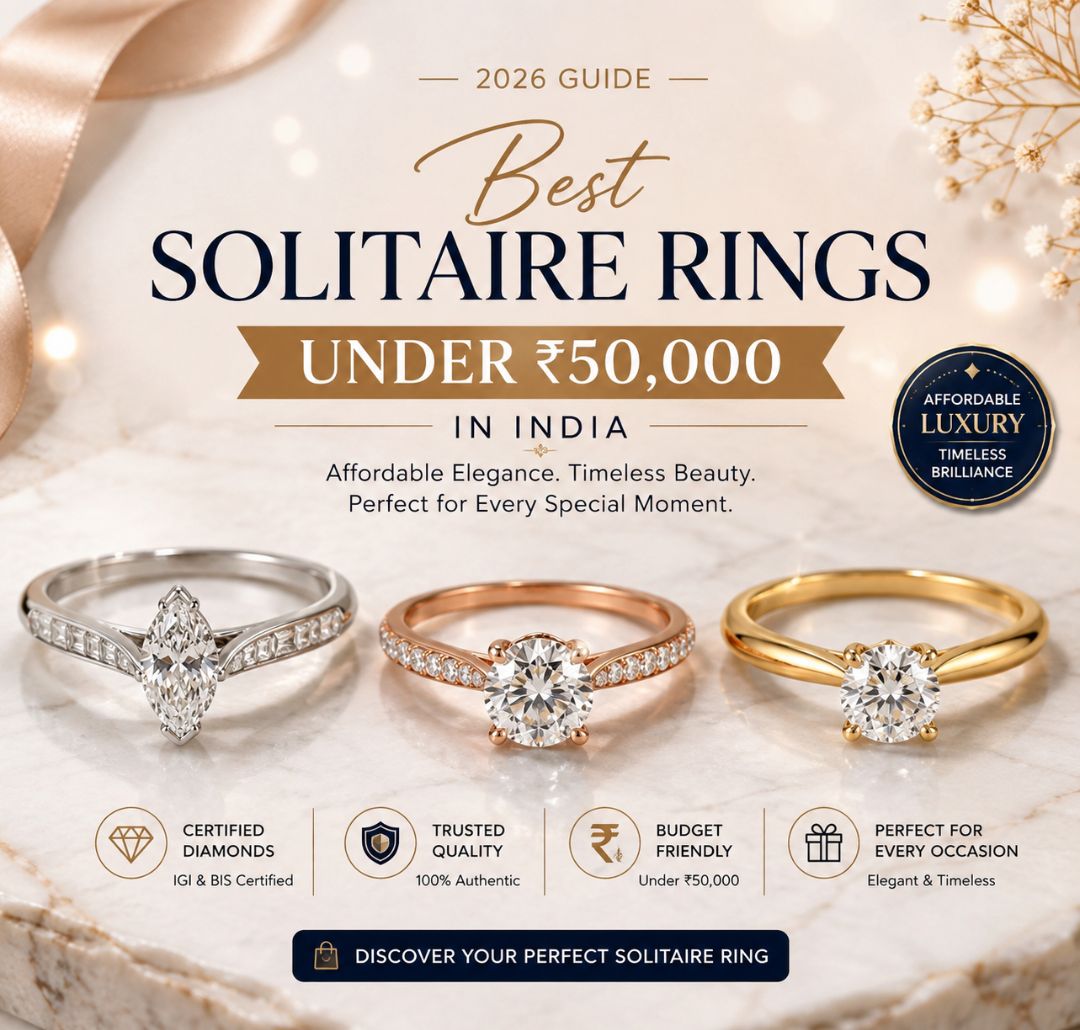
Best Solitaire Rings Under ₹50,000 in India (2026 Guide)
₹50,000 is, without question, the most searched-for and most shopped budget for solitaire and engagement rings in India today. It sits at an interesting crossroads - high enough to buy a genuine diamond ring with real certification, low enough that it's within reach for a young professional saving up for a proposal, a couple planning a registered wedding, or a first-time buyer who wants something meaningful without financial strain.
For years, this budget was considered "too small" for a proper diamond ring in India. Jewellers pushed cubic zirconia, moissanite, or diamond-look alternatives to anyone shopping under a lakh. That has changed. Lab grown diamonds - chemically, physically, and optically identical to mined diamonds - have made it possible to buy a real, IGI-certified solitaire ring under ₹50,000 without compromising on the stone, the setting, or the craftsmanship.
This guide walks through exactly what you can expect at this budget: which cuts and carat sizes make sense, how to read a certificate, which metals suit which skin tones and budgets, the mistakes most first-time buyers make, and how to compare lab grown against natural diamonds so you can buy with confidence rather than guesswork. Whether you're planning a proposal next month or simply researching before you walk into a store, by the end of this guide you'll know exactly what a good solitaire ring under ₹50,000 looks like - and what to avoid.
|
Quick Answer: Can you buy a genuine solitaire ring under ₹50,000? • Yes. With lab grown diamonds, ₹50,000 typically buys a 0.30–0.50 carat IGI-certified solitaire in a 4-prong or 6-prong setting in 18K gold. • The diamond is real - same carbon structure, same fire and brilliance as a mined diamond - just grown in a controlled lab environment rather than mined from the earth. • At this budget with natural diamonds, you'd typically be limited to 0.10–0.15 carat, which is why most buyers now choose lab grown for better size and clarity per rupee. |
Why Lab Grown Diamonds Offer Better Value
A lab grown diamond is created using CVD (Chemical Vapour Deposition) or HPHT (High Pressure High Temperature) technology that replicates the natural conditions under which diamonds form - just inside a controlled facility instead of underground over billions of years. The result is a stone with identical chemical composition, hardness (10 on the Mohs scale), and light performance to a natural diamond. Gemologically, there is no visual difference; even trained jewellers need specialised equipment to tell them apart.
The price difference exists because of supply chain economics, not because the diamond is "fake" or inferior. Mining, sorting, and distributing natural diamonds involves decades-old global supply chains with heavy markups at every stage. Lab grown production is more direct, which is why a lab grown diamond typically costs 60–80% less than a natural diamond of equivalent size and quality.
For a buyer working with ₹50,000, this difference is the reason a proper solitaire is even possible. Practically speaking:
· Bigger stone for the same money: a 0.40 carat lab grown solitaire costs roughly what a 0.10–0.12 carat natural diamond would.
· Better clarity and colour grades: you can afford VS clarity and F–G colour in lab grown, where the same budget in natural diamonds forces compromises on clarity or colour.
· Same certification standards: IGI grades lab grown diamonds using the same 4Cs criteria as natural diamonds, so you're not buying an unregulated product.
· Ethical and sustainable sourcing: no mining-related land disruption or the sourcing concerns associated with some natural diamond supply chains.
This is why lab grown has become the default choice for engagement and proposal rings among Indian buyers in the ₹30,000–₹1,00,000 range - it isn't a downgrade, it's simply a smarter allocation of the same budget.
What Makes a Good Solitaire Ring: The 4Cs
Every solitaire ring is judged on four fundamental characteristics of the diamond at its centre. Understanding these will help you evaluate any ring - from The6C or anywhere else - on merit rather than marketing.
Cut
Cut refers to how well a diamond's facets are proportioned and angled, and it's the single biggest factor in how much a diamond sparkles. A well-cut diamond reflects light efficiently between its facets and back out through the top, producing brilliance and fire. A poorly cut diamond can look dull even with excellent clarity and colour. At a ₹50,000 budget, prioritise cut grade (Excellent or Very Good on the certificate) over chasing a slightly bigger carat weight - a well-cut 0.35 carat stone will visibly outshine a poorly cut 0.45 carat one.
Clarity
Clarity measures internal inclusions and surface blemishes, graded from Flawless (FL) down to Included (I1–I3). For a solitaire under ₹50,000, VS1–VS2 or SI1 clarity is the sweet spot - inclusions at this level are invisible to the naked eye but the price jump to VVS or FL grades isn't necessary for everyday wear. Avoid I1 and below, where inclusions can affect both appearance and the stone's structural durability.
Colour
Diamond colour is graded D (completely colourless) to Z (visibly yellow/brown). For solitaires in white gold or platinum settings, F–H colour looks crisp and colourless to the eye at a fraction of the cost of a D-E-F "colourless" stone. If you're set on yellow or rose gold, you can comfortably go slightly warmer (H–I) since the metal tone masks any faint warmth in the stone.
Carat
Carat is simply the diamond's weight (1 carat = 200mg), not its visual size - cut and shape both affect how large a stone appears. Within a ₹50,000 budget on lab grown diamonds, expect to comfortably land between 0.30 and 0.50 carat depending on the shape, clarity, and colour combination you choose. Elongated shapes like oval, pear, and marquise tend to look larger than round or princess cuts at the same carat weight, which is a useful trick for maximising visual size on a budget.
Types of Solitaire Rings Under ₹50,000
The shape of the centre stone and the setting style both affect price, perceived size, and how the ring wears day to day. Here's how each option performs at this budget.
Round Solitaire
The most classic and most brilliant cut, with 58 facets engineered for maximum light return. Slightly more expensive per carat than fancy shapes due to higher rough diamond wastage during cutting, but the timeless choice for engagement rings.
Oval Solitaire
An elongated version of the round brilliant that appears larger than its actual carat weight and elongates the finger. Extremely popular for 2026 proposals and one of the best value-for-size shapes under ₹50,000.
Princess Cut
A square, modern cut with sharp corners and excellent brilliance. Slightly more affordable than round for the same carat weight, and pairs well with a 4-prong setting that protects the corners.
Emerald Cut
A rectangular step-cut with an open, elegant look and fewer, larger facets. It prioritises clarity display over sparkle, so choose a slightly higher clarity grade (VS1 or better) since inclusions are easier to spot in this cut.
Pear Shape
A teardrop silhouette that combines round brilliance with an elongated look. Flattering on most hand shapes and increasingly popular for those wanting something distinctive without going fully unconventional.
Marquise
A narrow, elongated shape with pointed ends that maximises apparent size per carat more than almost any other cut - a strong choice if visual impact per rupee is the priority.
Radiant Cut
A rectangular or square cut with trimmed corners and brilliant-style faceting, offering more sparkle than an emerald cut while keeping a similar silhouette.
Hidden Halo Solitaire
A small ring of pavé diamonds set beneath the centre stone, invisible from the top view but adding extra sparkle and perceived size from the side profile - a popular way to add drama without the cost of a full visible halo.
Prong Settings: 4-Prong vs 6-Prong
The setting holds the diamond in place and affects how much light enters the stone from the sides.
· Classic 4-Prong: shows off more of the diamond's surface area, giving a slightly bigger visual presence. Best suited to round, princess, and cushion shapes.
· 6-Prong: offers extra security for the stone and is often preferred for larger or more delicate shapes like pear and marquise, where extra grip at the points prevents chipping.
Best Metal Options for Your Solitaire
The metal you choose affects both the final look and how much of your ₹50,000 budget goes toward the band versus the stone.
|
Metal |
Best For |
Notes |
|
18K White Gold |
Most solitaire styles; classic, versatile look |
Rhodium-plated for extra shine; most popular choice for engagement rings in India |
|
18K Yellow Gold |
Warmer skin tones; traditional preference |
Pairs beautifully with slightly warmer colour-grade diamonds (H–I) |
|
18K Rose Gold |
Vintage and romantic styles |
Increasingly popular for 2026 proposals; flatters most skin tones |
|
Platinum |
Buyers prioritising durability and purity |
Denser and more scratch-resistant, but pushes cost up - expect a smaller carat trade-off at this budget |
Tip: 18K gold (as opposed to 22K or 24K) is the industry standard for rings because it strikes the right balance of durability and purity - pure gold is too soft for daily-wear jewellery like rings.
How Big a Diamond Can You Buy Under ₹50,000?
Exact pricing varies by shape, clarity, colour, and current lab grown diamond rates, but here is a realistic range to set expectations before you start browsing.
|
Budget |
Approx. Carat Range (Lab Grown) |
Typical Clarity/Colour |
|
₹25,000 – ₹30,000 |
0.20 – 0.25 ct |
SI1, G–H |
|
₹30,000 – ₹40,000 |
0.25 – 0.35 ct |
VS2–SI1, F–H |
|
₹40,000 – ₹50,000 |
0.35 – 0.50 ct |
VS1–VS2, F–G |
These ranges assume a standard 4-prong or 6-prong solitaire setting in 18K gold. Adding a hidden halo, a pavé band, or upgrading to platinum will shift the carat size down slightly for the same budget - that's a worthwhile trade-off if the design matters more to you than raw carat weight.
Buying Guide: What to Check Before You Buy
1. Certification first: confirm the diamond has an IGI (International Gemological Institute) certificate, which independently verifies the 4Cs and confirms the stone is genuinely lab grown.
2. Ask for the certificate number and cross-check it on IGI's own verification portal before making payment.
3. Check the cut grade specifically - many sellers highlight carat and price while glossing over cut quality, which affects sparkle more than any other factor.
4. Confirm the metal purity (hallmarked 18K gold) and ask whether the hallmark is BIS-certified.
5. Understand the return, resize, and buy-back policy in writing before you pay - ring sizing needs often change after the proposal.
6. Ask about warranty coverage for prong tightening, rhodium replating (for white gold), and stone security checks.
7. If buying online, check for a real photo or video of the actual stone/ring rather than only a stock catalogue image.
Mistakes to Avoid
· Chasing carat weight over cut quality - a bigger, poorly cut stone will sparkle less than a smaller, well-cut one.
· Buying without certification - an uncertified "diamond" ring at this price point is a red flag, not a bargain.
· Ignoring the band width and prong style, which affect how secure the stone is for daily wear.
· Not asking about resizing - nerves on proposal day mean ring sizes are often guessed, so a free one-time resize policy matters.
· Skipping the return/exchange window - always confirm this in writing, especially for online purchases.
· Assuming all "lab grown" listings are certified - always ask specifically for the IGI report, not just a brand assurance.
Lab Grown vs Natural Solitaire Rings: Full Comparison
Both are real diamonds. The difference is origin, price, and what that means for your budget.
|
Feature |
Lab Grown Diamond |
Natural Diamond |
|
Price (per carat) |
60–80% lower |
Market/rarity-driven, higher |
|
Sparkle & Fire |
Identical - same optical properties |
Identical - same optical properties |
|
Certification |
IGI certified (4Cs graded) |
IGI/GIA certified (4Cs graded) |
|
Durability |
10 on Mohs scale, same as natural |
10 on Mohs scale |
|
Resale Value |
Currently lower resale market |
Established resale/exchange market |
|
Ethics & Sourcing |
No mining impact; traceable origin |
Varies by source; look for certified conflict-free |
|
Best for ₹50,000 budget |
0.30–0.50 ct achievable |
0.10–0.15 ct typical |
The one honest trade-off is resale value - the lab grown resale market in India is still maturing, so natural diamonds currently hold slightly better long-term resale value. For a ring that's being bought to wear and cherish rather than as an investment asset, this rarely matters in practice.
Who Should Buy a Solitaire Ring Under ₹50,000?
· First-time engagement ring buyers who want a genuine certified diamond without stretching finances.
· Young professionals proposing on a self-funded budget, without family contribution.
· Couples who prioritise a memorable design over maximum carat weight.
· Buyers who plan to upgrade the stone later and want a well-made setting now.
· Anyone who wants a real diamond - not a diamond-look alternative like cubic zirconia or moissanite.
Proposal Ideas to Match Your Ring
A ring this thoughtfully chosen deserves a moment to match. A few ideas that pair well with a solitaire proposal:
· A quiet rooftop or terrace dinner at sunset, with the ring presented over dessert.
· A weekend getaway to a hill station or coastal town, proposing during a private walk.
· A home-based setup with candles, photographs from your relationship, and close family waiting nearby to celebrate right after.
· A destination that holds personal meaning - where you first met, had your first date, or travelled together.
How to Choose the Perfect Ring Size?
Getting the size right matters more than most buyers expect - a ring that's too tight or too loose changes how it's worn and how often it needs resizing.
1. If it's a surprise proposal, borrow a ring she already wears on the ring finger and get it measured, or discreetly ask a close friend or family member.
2. Use an online printable ring sizer or a piece of string measured against a ruler as a rough guide before your appointment.
3. When in doubt, size up slightly rather than down - a loose ring is easier and cheaper to resize than one that's too tight.
4. Confirm The6C's resizing policy at the time of purchase so the first resize (if needed) is covered.
Why Buy from The6C
The6C designs and sets lab grown diamond jewellery for buyers who want a genuine stone, honest pricing, and a ring that's actually ready to wear every day - not just for the photos.
· IGI Certified Diamonds: every solitaire comes with independent IGI certification, so you know exactly what you're paying for.
· Ethically Sourced: lab grown diamonds with a traceable, conflict-free origin.
· Modern, Wearable Designs: settings built for daily wear, not just display - secure prongs, comfortable band profiles, and finishes that hold up over time.
· Premium Craftsmanship: hallmarked gold, precise stone-setting, and quality checks before a ring leaves the workshop.
· Lifetime Support: ongoing assistance with resizing, cleaning, and prong checks well after your purchase.
· Genuine Value: transparent pricing with no inflated "discount" tags - the price you see reflects the diamond and craftsmanship you're getting.
What Our Customers Say
|
Customer Reviews · "I was skeptical about lab grown at first, but once I saw the certificate and the sparkle side-by-side, the choice was obvious. The ring looked far more expensive than what we paid." - Verified Buyer · "The team helped us pick a shape that suited her hand and stayed within budget without any pressure to upsell." - Verified Buyer · "Resizing after the proposal was quick and free, exactly as promised at the time of purchase." - Verified Buyer |
Frequently Asked Questions
Is ₹50,000 enough for a solitaire ring?
Yes. With lab grown diamonds, ₹50,000 comfortably buys a certified 0.30–0.50 carat solitaire in 18K gold, depending on the shape, clarity, and colour combination you choose.
Is a lab grown diamond real?
Yes. A lab grown diamond has the same carbon crystal structure, hardness, and optical properties as a natural diamond. The only difference is that it's grown in a controlled lab environment instead of being mined from the earth.
Which cut looks biggest for the same carat weight?
Elongated shapes - oval, marquise, and pear - tend to appear larger than round or princess cuts at the same carat weight because they cover more surface area on the finger.
What carat can I buy under ₹50,000?
Typically between 0.30 and 0.50 carat in lab grown diamonds, depending on your chosen clarity, colour, and shape.
Is IGI certification important?
Yes. IGI certification independently verifies the diamond's 4Cs and confirms it's genuinely lab grown, protecting you from overpaying for an uncertified or misrepresented stone.
Can I customise my ring?
Yes. Shape, metal colour, prong style, and band design can typically be customised to fit your preferences and budget.
What's the difference between IGI and GIA certification?
Both are respected independent gemological labs. IGI is widely used for lab grown diamonds in India and offers strong regional support for verification and after-sales service.
Will a lab grown diamond pass a diamond tester?
Yes. Since it's chemically identical to a natural diamond, a lab grown diamond passes standard diamond testers, which measure thermal conductivity, not origin.
Does a lab grown diamond lose its sparkle over time?
No. Diamonds - lab grown or natural - do not lose brilliance with age. Occasional professional cleaning keeps the setting free of dust and oils that can dull the appearance.
Is a solitaire ring only for engagements?
No. Solitaires are also popular as anniversary gifts, self-purchase pieces, and everyday luxury wear, not exclusively for proposals.
Should I choose white gold or platinum?
White gold offers the same bright look at a lower cost, making it the practical choice at a ₹50,000 budget. Platinum is denser and more scratch-resistant but costs more for the same design.
Can I exchange or upgrade my diamond later?
Many jewellers, including The6C, offer upgrade or exchange programs - confirm the specific terms at the time of purchase.
How do I know my ring size without visiting a store?
Use a printable ring sizer or measure an existing ring she wears, and cross-check with a string-and-ruler method as a backup.
Are lab grown diamonds a good long-term investment?
Diamonds - lab grown or natural - are best bought for their beauty and meaning rather than as a financial investment, since resale markets for both are modest compared to gold.
How long does delivery take after ordering?
This depends on whether the ring is ready-to-ship or made-to-order with customisation; most made-to-order pieces take a few weeks for setting and quality checks.
What documentation will I receive with my purchase?
You'll receive the IGI certificate for the diamond, a purchase invoice, and details of the warranty and resizing policy.
Conclusion
A solitaire ring under ₹50,000 is no longer a compromise - it's simply a smart, well-informed choice. Lab grown diamonds have made it possible to buy a genuinely certified stone, in a size and clarity that would be out of reach with natural diamonds at the same budget, without cutting corners on craftsmanship or certification.
The right ring comes down to matching shape, metal, and setting to the person who'll wear it every day - not just to what looks good in a single photo. Take the time to compare cut quality, confirm certification, and ask the right questions before you buy.
Ready to find the one? Explore The6C's solitaire ring collection online, or book a one-on-one consultation with our team to see certified lab grown diamonds in person and get guided help choosing the right ring for your budget and story.