
Article: Which Diamond Shape Looks Biggest? Size Comparison Guide (2026) | The6C
Which Diamond Shape Looks Biggest? Size Comparison Guide (2026) | The6C
Place two 1-carat diamonds side by side and ask most buyers which one is heavier. They'll almost always point to the wrong one. That's because carat is a measure of weight, not size and when it comes to what your eye actually sees resting on a finger, weight is only part of the story. Two stones of identical carat weight can differ in visible surface area by 10% or more, purely because of how their shape distributes that weight.
This is the single most important thing to understand before you spend money on a diamond: the shape you choose determines how big your diamond looks far more than the number on the certificate. If you've been searching for which diamond shape looks biggest, the honest answer is that elongated shapes win but understanding why will save you money and help you buy a stone that looks a full half-carat larger than it actually weighs.
Throughout this guide we'll break down four concepts that jewellers use every day but rarely explain to customers: face-up size (the outline your eye sees from above), diamond spread (how efficiently the stone uses its weight across the top rather than hiding it in depth), shape illusion (how elongated outlines trick the eye into reading "bigger"), and finger coverage (how much of your finger the stone actually spans). Master these four and you'll never overpay for hidden carat weight again.
Quick Answer (Which Diamond Shape Looks Biggest?)
Marquise diamonds look the biggest for their carat weight, followed by pear, oval, and emerald cuts. These elongated shapes spread their weight across a larger surface area rather than hiding it in depth, giving them more face-up size and greater finger coverage than round or princess cuts. A 1-carat marquise can appear up to 15% larger than a 1-carat round diamond.

Why Diamond Shape Matters More Than Carat Weight
Carat weight tells you how much a diamond weighs; it tells you almost nothing about how big it looks. A well-cut round diamond hides a surprising amount of its weight in its depth the portion below the girdle that sits down inside the setting where nobody sees it. Elongated shapes do the opposite: they push weight outward and upward into visible area.
Five factors decide perceived size:
Face-up area. This is the two-dimensional footprint of the stone viewed from directly above. It's the number that matters most, because it's literally what people see. Marquise and pear cuts have the largest face-up area per carat of any shape.
Spread. A diamond that carries its weight in the crown and table rather than deep in the pavilion is said to have good "spread." Shallow-cut and elongated stones spread more; deep stones spread less. Spread is why two 1-carat ovals can look noticeably different in size.
Optical illusion. The human eye reads length as size. An elongated outline draws the gaze along its longest axis, making the whole stone register as larger than a compact shape of equal area. This is pure perception, but it's real and it's powerful.
Finger coverage. A long stone spans more of the finger from knuckle toward the base, which reads as a bigger, more commanding ring — even when the actual carat weight is modest.
Length-to-width ratio. This is the mathematical driver behind the illusion. A ratio of 2.00 means a stone is twice as long as it is wide. Higher ratios exaggerate the elongated effect and maximise apparent size.
💡 Expert Tip: Never buy a diamond on carat weight alone. Ask the seller for the actual millimeter dimensions and the length-to-width ratio. Two stones at the same price and carat can differ dramatically in how large they appear.
Diamond Shapes Ranked by Visual Size
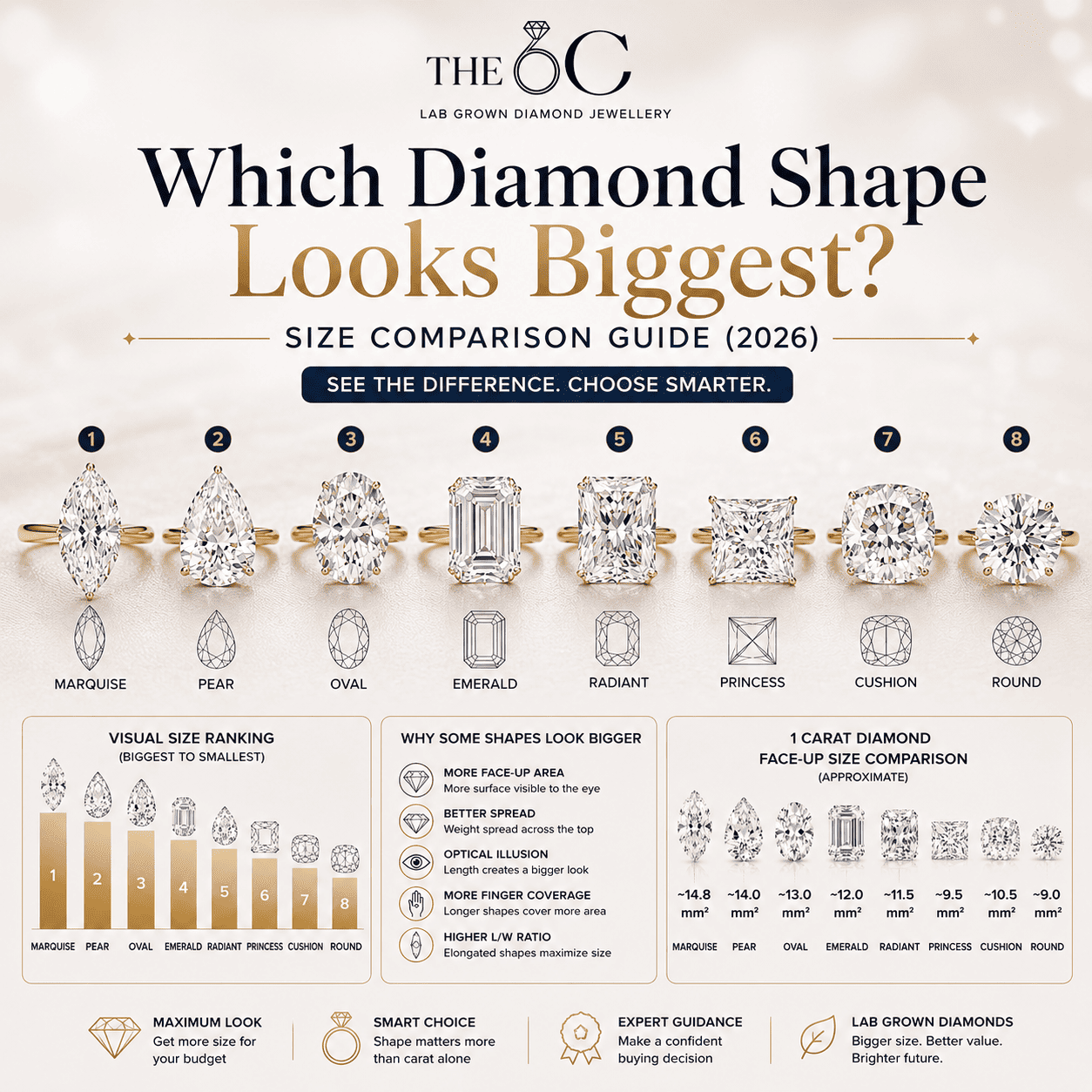
Here is how the major shapes rank from largest-looking to smallest-looking at an identical carat weight. Every shape has trade-offs, so we've included the honest pros and cons of each.
1. Marquise — The undisputed size champion. Its pointed, elongated football outline gives it the largest face-up area of any cut and maximum finger coverage. Pros: looks biggest, slimming on the finger, vintage-glamour appeal. Cons: pointed tips are vulnerable to chipping and need protective settings; can show a dark "bow-tie" shadow across the centre if poorly cut.
2. Pear — A teardrop combining a rounded end with a single point. Nearly as large-looking as marquise with a softer, more modern silhouette. Pros: excellent size-per-carat, flattering elongation, only one vulnerable point. Cons: the point still needs protection; bow-tie effect possible; requires careful symmetry.
3. Oval — The most popular elongated shape and the best all-rounder. Large face-up size with the brilliant sparkle of a round cut and no sharp points to chip. Pros: big look, brilliant sparkle, durable, extremely on-trend. Cons: can show a bow-tie; premium pricing due to demand.
4. Emerald — A rectangular step cut with long, elegant lines. Its length makes it look large, though its open "hall-of-mirrors" facets flash rather than sparkle. Pros: elongated, sophisticated, often cheaper per carat, makes the finger look slender. Cons: less sparkle; shows inclusions and colour more readily, so a higher clarity grade is needed.
5. Radiant — A cropped-corner rectangle that blends emerald's elongation with brilliant faceting. Pros: good size, strong sparkle, durable corners, hides inclusions well. Cons: can look slightly less "designer" than oval; quality varies widely.
6. Princess — A square brilliant. Compact but sparkly, with a smaller face-up area because much of its weight sits in the depth. Pros: modern, brilliant, good value per carat. Cons: looks smaller than elongated cuts; sharp corners need protection.
7. Cushion — A rounded-square "pillow" shape. Romantic and soft but compact, with weight carried in the depth. Pros: vintage charm, brilliant or chunky faceting options, hides inclusions. Cons: one of the smaller-looking cuts per carat.
8. Round — The most brilliant shape in the world and the sparkle king — but the smallest-looking per carat, because its ideal cut demands significant depth that hides weight below the girdle. Pros: unmatched fire and brilliance, timeless, hides colour. Cons: smallest face-up size; most expensive per carat.
Comparison Table: Shapes at a Glance
| Diamond Shape | Looks Bigger? | Avg Face-Up Area | Finger Coverage | Sparkle | Popularity | Best For |
|---|---|---|---|---|---|---|
| Marquise | ★★★★★ | Largest | Maximum | High | Niche/Vintage | Maximum size, dramatic look |
| Pear | ★★★★★ | Very Large | Very High | High | Rising | Elongation with softness |
| Oval | ★★★★☆ | Large | High | Very High | Very High | Best all-rounder |
| Emerald | ★★★★☆ | Large | High | Moderate | High | Elegant, understated luxury |
| Radiant | ★★★☆☆ | Above Avg | Above Avg | Very High | Moderate | Sparkle + size + durability |
| Princess | ★★★☆☆ | Average | Average | High | Moderate | Modern square look, value |
| Cushion | ★★☆☆☆ | Below Avg | Below Avg | High | High | Vintage romance |
| Round | ★★☆☆☆ | Smallest | Lowest | Highest | Highest | Maximum sparkle, timeless |
Actual 1-Carat Diamond Dimensions
Here's where theory becomes concrete. Below are the approximate face-up millimetre dimensions of a well-cut 1-carat diamond in each shape. Notice how the longest dimension climbs as shapes elongate — that longest measurement is what your eye reads as "size."
| Shape | Approx. 1-Carat Dimensions (mm) |
|---|---|
| Round | 6.4 × 6.4 |
| Princess | 5.5 × 5.5 |
| Cushion | 5.5 × 5.5 |
| Radiant | 6.1 × 5.1 |
| Emerald | 6.9 × 5.0 |
| Oval | 7.7 × 5.5 |
| Pear | 8.8 × 5.5 |
| Marquise | 10.5 × 5.0 |
A 1-carat round measures roughly 6.4 mm across. A 1-carat marquise stretches to about 10.5 mm along its length — over 60% longer in its dominant dimension. Even though both weigh exactly one carat, the marquise commands far more visual real estate. This is the mathematical proof behind the illusion: elongated shapes convert the same carat weight into a longer, more visible footprint.
📌 Did You Know? A 1-carat oval and a 1.25-carat round can look almost the same size face-up. Choosing the oval could save you a significant premium while delivering the same visual impact.
Face-Up Size Explained
Face-up size is the visible surface area of a diamond when viewed from directly above, as it sits in a ring on a finger. It is the single most useful metric for judging how big a diamond will actually look, because it ignores hidden depth and measures only what the eye perceives.
Why it matters: carat is weight; face-up size is appearance. A deeply cut diamond can weigh a full carat yet present a small face-up outline because much of its mass is buried in the pavilion. A well-spread stone of the same weight shows more of itself on top.
How depth percentage affects appearance: depth percentage is the height of the diamond divided by its width. A high depth percentage means the stone is carrying weight downward, out of sight — resulting in a smaller face-up appearance. A lower (but still well-cut) depth percentage spreads weight outward, enlarging the visible outline. For maximum apparent size, look for shapes and cuts with efficient spread rather than excessive depth.
✅ Buying Advice: When comparing two diamonds of equal carat and price, choose the one with the larger millimetre dimensions and the more favourable spread. You're paying the same for a bigger-looking stone.
Oval vs Round Diamond
This is the most common size dilemma buyers face, because round is the default and oval is the size-savvy alternative.
| Factor | Oval | Round |
|---|---|---|
| Looks Bigger | ✅ Yes — ~10% larger face-up | Smaller per carat |
| Sparkle | Excellent (brilliant faceting) | Best in class |
| Price per carat | Lower | Higher |
| Popularity | Very high, trend-leading | Timeless bestseller |
| Finger Coverage | Greater (elongated) | Less |
Oval pros: looks bigger, costs less per carat, brilliant sparkle, elongates the finger, no vulnerable points. Oval cons: can display a bow-tie shadow if poorly cut. Round pros: unrivalled fire and brilliance, hides colour and inclusions well, never goes out of style. Round cons: smallest face-up size, most expensive per carat.
Winner for size and value: Oval. For pure timeless sparkle, round still reigns.
Marquise vs Oval Diamond
If oval is the smart choice, marquise is the maximalist choice.
| Factor | Marquise | Oval |
|---|---|---|
| Appearance | Most elongated, dramatic | Elegant, balanced |
| Sparkle | High | Very high |
| Durability | Lower (two pointed tips) | Higher (no points) |
| Price per carat | Lower | Moderate |
| Popularity | Niche, vintage revival | Mainstream favourite |
| Finger Coverage | Maximum | High |
Who should buy marquise: anyone who wants the absolute largest look per carat, loves vintage drama, and is willing to choose a protective setting for the tips.
Who should buy oval: anyone who wants a big, elongated look with easier durability, more mainstream appeal, and maximum brilliance.
<a name="why-elongated"></a>
Why Elongated Diamond Shapes Look Bigger
Elongated shapes look bigger for three compounding reasons.
First, length-to-width ratio. A round diamond has a ratio of 1.00 — perfectly symmetrical. An oval typically runs 1.35–1.50, a pear 1.50–1.75, and a marquise 1.85–2.10. The higher the ratio, the more the stone stretches, and the more dramatically the eye reads it as large.
Second, visual illusion. The eye tracks along the longest axis of an object and estimates size from that dominant line. A long stone therefore registers as bigger than a compact stone of the exact same area — the brain is fooled by the elongation.
Third, surface area and finger coverage. Elongated cuts distribute their carat weight across a longer footprint, physically covering more of the finger. Oval, pear, marquise, and emerald all exploit this, which is why these four dominate every "looks bigger" recommendation.
⚡ Quick Facts: The four biggest-looking mainstream shapes are marquise, pear, oval, and emerald — all elongated. The four most compact are round, cushion, princess, and Asscher — all symmetrical.
Diamond Shapes by Finger Type
The "biggest" shape isn't automatically the best shape for your hand. Here's how to match shape to finger.
Small fingers: oval, pear, and marquise elongate and slim short fingers, creating length. Avoid very wide cushions.
Long fingers: you can wear almost anything round, cushion, and princess look beautifully balanced and won't over-elongate.
Wide fingers: elongated shapes and larger stones balance broader fingers; very small or narrow stones can look lost.
Slim fingers: round, princess, and cushion suit slender fingers well; a modest elongated stone also flatters.
Petite hands: oval and pear add graceful length without overwhelming a small hand.
Large hands: go bigger — marquise, emerald, and generous ovals hold their presence and won't look under-scaled.
Best Ring Settings That Make Diamonds Look Bigger
The setting can add the visual equivalent of a half-carat — for free. Here's how each performs.
Solitaire: clean and classic; lets the stone speak but adds no size boost. Halo: a ring of small diamonds encircles the centre stone, dramatically inflating perceived size — often making a stone look a full size grade larger. Hidden Halo: a halo tucked under the crown adds sparkle and lift without visually widening the outline; a subtle size booster. Cathedral: arches lift the stone up and forward, giving it prominence and apparent height. Split Shank: the band splits as it approaches the centre, framing the stone and making it appear larger by contrast. Bezel: a metal rim can either enlarge (if the rim extends the outline) or slightly shrink the perceived stone; choose a thin, extended bezel for a bigger look. East-West: setting an elongated stone horizontally across the finger is a modern trick that emphasises its length and coverage. Three Stone: side stones extend the total width, making the whole ring read larger even if the centre is modest.
🏆 Expert Tip: Pairing an oval or pear centre with a halo setting is the single most effective size-maximising combination in modern jewellery. You get an elongated stone and a size-inflating frame.

Biggest Mistakes Buyers Make
Buying on carat alone. Carat is weight, not size. Always check millimetre dimensions.
Ignoring depth percentage. A deep stone hides weight below the girdle and looks smaller than its carat suggests.
Ignoring table percentage. The table (the flat top facet) influences both sparkle and spread; extremes hurt appearance.
Choosing thick bands. A chunky band makes the centre stone look smaller by comparison. Thinner bands enlarge the stone visually.
Choosing poor cut grades. A badly cut diamond leaks light, looks dull, and often looks smaller. Cut quality is non-negotiable.
Choosing the wrong setting. A solitaire on a modest stone misses the free size boost a halo would deliver.
Ignoring proportions. Bow-tie shadows, off ratios, and uneven symmetry all shrink and cheapen the look. Always review proportions.
Best Diamond Shape by Budget
Lab-grown diamonds change this maths entirely, because they deliver two to three times the size for the same spend as mined stones. Here's how to maximise visible size at each level. (Prices are indicative for IGI-certified lab-grown diamonds and vary by clarity, colour and setting.)
Under ₹50,000: a lab-grown oval or pear in the 0.5–0.7 carat range gives strong finger coverage and brilliant sparkle at entry-level spend.
₹50,000–₹1,00,000: step up to a 0.75–1.0 carat lab-grown oval, pear, or marquise for a genuinely impactful, elongated look.
₹1,00,000–₹2,00,000: a 1.0–1.5 carat lab-grown elongated stone with a halo setting delivers a look that rivals a 2-carat mined solitaire.
Above ₹2,00,000: go for 2 carat and up in lab-grown oval, marquise, or emerald — flagship presence, ideal cut, and premium clarity, all achievable because lab-grown stretches every rupee.
Lab-Grown vs Natural Diamonds
Do lab-grown diamonds look different? No. A lab-grown diamond is chemically, physically, and optically identical to a mined diamond. Under magnification only specialised equipment can tell them apart, which is why both are certified by the same laboratories.
Do they appear larger? For the same budget, yes — significantly. Because lab-grown diamonds cost far less per carat, the same spend buys a larger stone, more face-up size, and more finger coverage. This is the real "looks bigger" advantage most buyers overlook: shape maximises size for a given carat, but lab-grown maximises the carat you can afford in the first place.
Do they sparkle differently? No — identical refractive index means identical fire and brilliance. Sparkle depends on cut quality, not origin.
Which offers better value? Lab-grown, decisively, for size-per-rupee. That's exactly why The6C specialises in IGI-certified lab-grown diamond jewellery — letting you choose a bigger, better-cut elongated stone than a mined budget would ever allow, without compromising on certification or sparkle.
Expert Buying Tips
- Prioritise cut quality above all — it drives both sparkle and apparent size.
- Always request the millimetre dimensions, not just the carat.
- Check the length-to-width ratio for elongated shapes (oval ~1.35–1.50, marquise ~1.85–2.10).
- Choose a thin band to make the centre stone look larger.
- Consider a halo setting for an instant size upgrade.
- Inspect elongated stones for a bow-tie shadow and reject dark ones.
- Buy lab-grown to double or triple your visible carat for the budget.
- For emerald and Asscher cuts, buy higher clarity — step cuts reveal inclusions.
- Match shape to finger type, not just to what looks biggest online.
- Don't over-pay for a high colour grade in a shape that hides colour well (round, marquise).
- Verify certification from IGI or GIA before purchase.
- Pair elongated stones with claw or protective settings to guard pointed tips.
- View diamonds on a real hand, not on a display card, before deciding.
- Consider east-west settings to showcase an elongated stone's length.
- Remember spread: a shallower well-cut stone of the same carat looks bigger than a deep one.
- Use three-stone or split-shank settings to broaden overall ring width.
- Compare stones under the same lighting — sparkle and size read differently in different light.
Decision Guide
START: What matters most to you?

├── MAXIMUM SIZE per carat?
│      ├── Love vintage drama & OK with protecting tips? → MARQUISE
│      └── Want softness with size? → PEAR
│
├── BEST ALL-ROUNDER (size + sparkle + durability)?
│      └── → OVAL
│
├── ELEGANT, UNDERSTATED, elongated luxury?
│      └── → EMERALD
│
├── MODERN SQUARE look with value?
│      └── → PRINCESS or RADIANT
│
├── VINTAGE ROMANCE?
│      └── → CUSHION
│
└── MAXIMUM SPARKLE & TIMELESS above all?
       └── → ROUND
<a name="final-verdict"></a>
Final Verdict
If the question is simply which diamond shape looks biggest, the answer is marquise, closely trailed by pear and oval — all elongated shapes that convert carat weight into visible surface area and finger coverage.
But "biggest" isn't the only goal, so here's our shape recommendation by priority:
- Best for size: Marquise or Pear
- Best for sparkle: Round
- Best all-rounder (size + sparkle + durability): Oval
- Best for luxury and elegance: Emerald
- Best for everyday wear: Oval or Round (no fragile points)
- Best for engagement rings overall: Oval — it looks large, sparkles brilliantly, suits every finger, and leads the trends of 2026
And whichever shape you choose, choosing lab-grown is what lets you buy it bigger, better-cut, and fully certified — without stretching the budget.
9. Featured Snippet Answers
Which diamond shape looks biggest? Marquise diamonds look the biggest for their carat weight, followed by pear, oval, and emerald. These elongated shapes spread their weight across a larger surface area, giving greater face-up size and finger coverage than round or princess cuts.
Does oval look bigger than round? Yes. An oval diamond looks roughly 10% larger than a round diamond of the same carat weight, because its elongated shape spreads across a greater surface area and covers more of the finger.
Why do elongated diamonds look bigger? Elongated diamonds look bigger because their length-to-width ratio stretches the stone across a larger footprint, the eye reads length as size, and the extra surface area covers more of the finger.
What is face-up size? Face-up size is the visible surface area of a diamond seen from directly above as it sits in a ring. It determines how large a diamond actually looks, regardless of its carat weight or hidden depth.
What is diamond spread? Diamond spread describes how efficiently a diamond carries its weight across the top rather than hiding it in depth. A well-spread stone looks larger face-up than a deep stone of the same carat weight.
Comparison Tables
(All eight tables are embedded inline in the article above: Shapes at a Glance; 1-Carat Dimensions; Oval vs Round; Marquise vs Oval — plus ranked list, finger-type, settings, and budget breakdowns rendered as structured sections. Reproduced here as a checklist for the CMS:
✔ Shapes at a Glance
✔ 1-Carat Dimensions
✔ Oval vs Round
✔ Marquise vs Oval.)
FAQ
- Which diamond shape looks biggest?
- Marquise looks biggest per carat, followed by pear, oval, and emerald — all elongated shapes.
2. Does oval look bigger than round?
Yes, an oval looks about 10% larger than a round of the same carat weight.
3. Does marquise look bigger than oval?
Yes. Marquise has the largest face-up area of any shape and covers more of the finger than oval.
4. Which diamond has the largest face-up area?
Marquise, thanks to its long, pointed outline and high length-to-width ratio.
5. Which diamond sparkles the most?
Round brilliant sparkles most, due to its 57–58 optimally angled facets.
6. Which shape is best for engagement rings?
Oval is the best all-round engagement ring shape big-looking, brilliant, durable, and on-trend for 2026.
7. Which diamond shape is cheapest?
Per carat, emerald, marquise, and pear are typically cheaper than round.
8. Which shape hides inclusions best?
Brilliant cuts like round, oval, radiant, and cushion hide inclusions best; emerald and Asscher reveal them.
9. Which diamond shape is most durable?
Round is most durable; shapes with points (marquise, pear) need protective settings.
10. Which diamond shape is trending in 2026?
Oval leads, with pear and elongated cushion cuts rising fast.
11. Do lab-grown diamonds look bigger?
For the same budget, yes — lab-grown costs less per carat, so you can afford a larger stone.
12. Do lab-grown diamonds sparkle less?
No. They are optically identical to mined diamonds and sparkle exactly the same.
13. What length-to-width ratio looks best for an oval?
A ratio of 1.35–1.50 is the sweet spot for a balanced, elongated oval.
14. Does a halo make a diamond look bigger?
Yes. A halo can make a centre stone look up to a full size grade larger.
15. Does a thin band make a diamond look bigger?
Yes. A thinner band increases the visual contrast, making the centre stone appear larger.
16. What is a bow-tie in a diamond?
A dark shadow across the centre of elongated shapes caused by poor cutting; choose stones with a faint or invisible bow-tie.
17. Which shape is best for small fingers?
Oval, pear, and marquise elongate and flatter small fingers.
18. Which shape is best for large hands? Marquise, emerald, and generous ovals hold presence on larger hands.
19. Is carat the same as size?
No. Carat is weight; size is what the eye sees, driven by shape and cut.
20. Which shape gives the best value for size?
Oval and pear give the best balance of large appearance, sparkle, and price.
21. Should I choose depth percentage low or high for a bigger look?
A lower (well-cut) depth spreads weight outward for a larger face-up look; avoid overly deep stones.
22. Is emerald cut a good choice for looking bigger?
Yes — its elongated rectangle looks large, but buy higher clarity as it shows inclusions.
23. Which is better for size, princess or cushion?
Both are compact; princess edges slightly larger due to its square brilliant spread.
24. Can a setting really change how big a diamond looks?
Absolutely — halo, hidden halo, and three-stone settings can add significant perceived size.
25. Which lab-grown diamond shape should first-time buyers choose?
Oval — the safest, most flattering, biggest-looking, and most versatile choice.