
Article: Marquise Cut Lab Grown Diamonds Guide 2026 | The6C
Marquise Cut Lab Grown Diamonds Guide 2026 | The6C
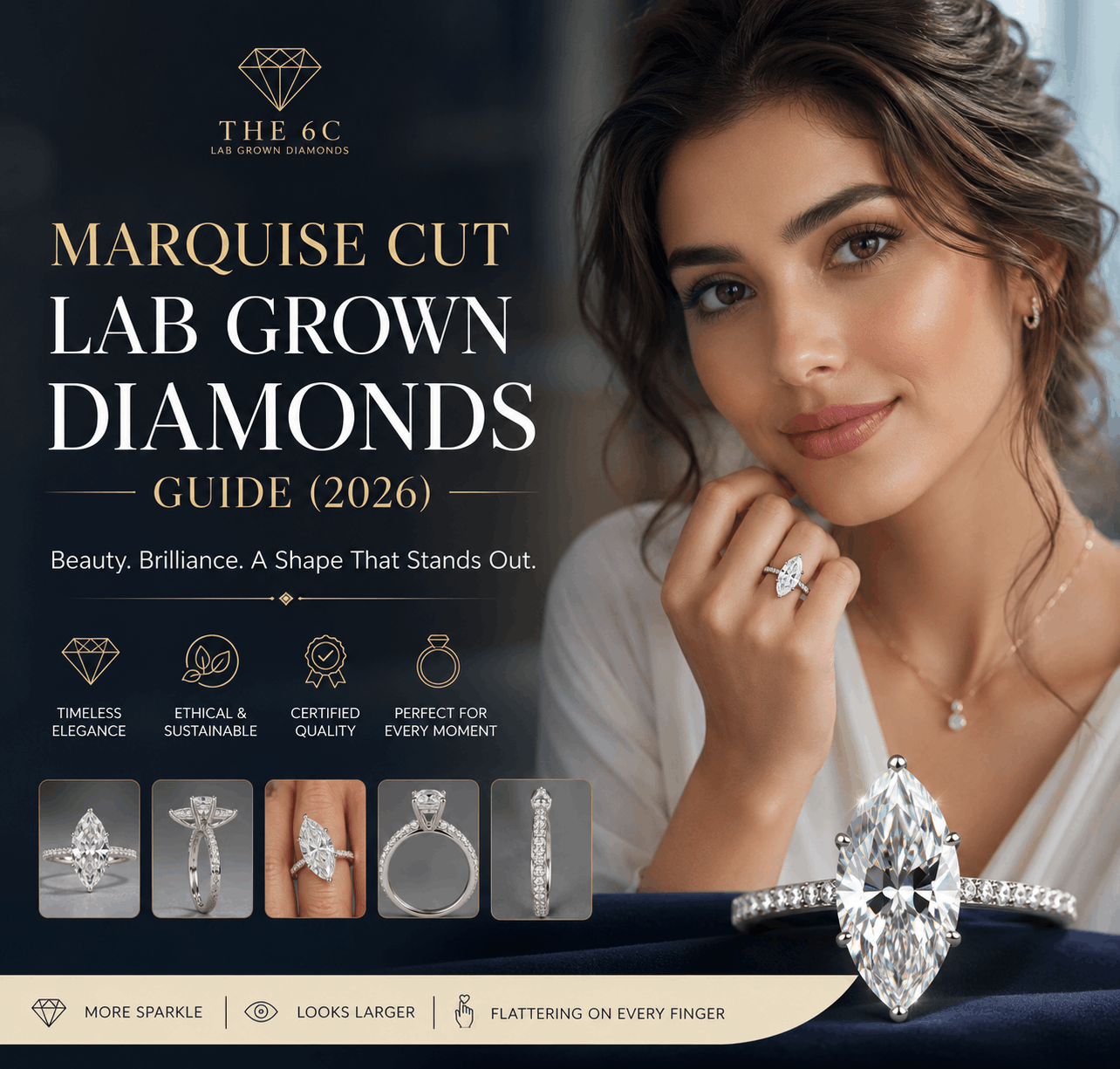
There's a reason marquise cut lab grown diamonds keep showing up on the hands of stylish brides-to-be and in the sketchbooks of custom jewellery designers this year. The elongated, boat-shaped silhouette - pointed at both ends, generous through the middle - does something few other cuts can: it makes a diamond look bigger than its carat weight, elongates the finger, and carries an unmistakable vintage romance that feels perfectly at home in 2026's return to old-world glamour.
Add a lab grown origin to that shape, and you get a stone that's chemically, optically, and structurally identical to a mined diamond, at a price that lets you go bigger, cleaner, or both. This guide walks through everything worth knowing before you buy - the history and anatomy of the cut, honest pros and cons, how to judge quality, which settings suit it best, how it stacks up against other popular shapes, and the mistakes that trip up first-time buyers.
What Is a Marquise Cut Diamond?
A marquise cut diamond is an elongated, navette (boat-shaped) diamond with symmetrical points at both ends and a curved brilliant-faceted body, typically cut with 56 to 58 facets to maximise light return along its length.
The shape belongs to the family of fancy shape diamonds - anything that isn't round - and shares its brilliant faceting style with round, oval, and pear cuts, which is why it sparkles the way it does rather than showing the flatter "hall of mirrors" look of step cuts like emerald.
The Origin of the Name
Jewellery lore traces the marquise cut back to 18th-century France, where King Louis XV is said to have commissioned a diamond shaped to echo the smile of his mistress, the Marquise de Pompadour. Whether or not the anecdote is precisely accurate, the name has stuck for nearly three centuries, and the cut has cycled in and out of fashion ever since - always returning when vintage and Art Deco aesthetics come back into favour, as they have now.
Why the Shape Reads Larger
Because the marquise stretches its surface area across a longer, narrower outline instead of a compact round one, it maximises visible face-up size for its carat weight. A 1.50-carat marquise will typically look noticeably larger than a 1.50-carat round or cushion diamond of the same weight - one of the biggest reasons buyers gravitate toward it when they want visual impact without stepping up in carat.
Why Choose Lab Grown Marquise Diamonds?
Lab grown marquise diamonds are grown in controlled laboratory environments using CVD (Chemical Vapour Deposition) or HPHT (High Pressure High Temperature) processes that replicate the natural conditions under which diamonds form underground - the result is a diamond with the same crystal structure, hardness, fire, and brilliance as a mined stone.
• Chemically and optically identical: A lab grown diamond has the same carbon crystal lattice as a mined diamond - no gemologist can tell the two apart without specialised lab equipment, and even then, the stone is still 100% diamond.
• Certified quality: Reputable lab grown marquise diamonds come with certification from labs such as IGI or GIA, grading cut, color, clarity, and carat exactly as they would for a mined stone.
• Better value at the same specifications: Because lab grown diamonds skip the cost and complexity of mining, they generally cost meaningfully less than a mined diamond of comparable size and grade, letting you allocate budget toward a better cut, a larger carat, or a more elaborate setting.
• Ethical and sustainable sourcing: Lab grown diamonds sidestep the environmental disruption and supply-chain opacity associated with traditional mining, making them a natural fit for buyers who care about conflict-free, sustainable jewellery.
• Same sparkle, same durability: A lab grown diamond still ranks 10 on the Mohs hardness scale, so day-to-day wear, brilliance, and fire perform exactly as they would with a mined marquise diamond.
Pros of Marquise Cut Lab Grown Diamonds
The marquise cut earns its comeback on genuine merit, not just nostalgia. Here's what buyers consistently love about it.
• Looks larger than round diamonds of the same carat weight, thanks to its elongated silhouette and greater surface area.
• Finger-flattering illusion: the elongated shape visually slims and lengthens the finger, a quality few other cuts offer as dramatically.
• Distinctly vintage, statement-making style that stands apart from the ubiquity of round and oval solitaires.
• Strong brilliance: the brilliant facet pattern delivers plenty of fire and scintillation, especially in a well-cut stone.
• Excellent value: pairing the shape's larger face-up appearance with a lab grown origin often means more visual size for the money.
• Versatile styling: it suits solitaires, halos, three-stone designs, and both classic north-south and dramatic east-west orientations.
Potential Drawbacks (and How to Avoid Them)
No diamond shape is without trade-offs. Marquise cut diamonds have a few well-known quirks - all manageable with the right buying knowledge.
The Bow-Tie Effect
Many elongated shapes, marquise included, can show a bow-tie - a dark shadow across the centre of the stone caused by light not returning evenly through the pointed ends. A well-proportioned cut with strong symmetry minimises this dramatically, so it pays to view the stone (or a clear video of it) before buying, and to favour cutters known for consistent symmetry grading.
Pointed Tips Need Protection
The sharp points at each end are the most vulnerable part of the stone and can chip if knocked against a hard surface without protection. This is a setting decision, not a reason to avoid the shape - V-tip prongs, bezel accents at the points, or a protective halo around the tips are all effective, widely used solutions.
Symmetry Matters More Than Usual
Because the eye is drawn along the full length of the stone, even small asymmetries between the two halves or ends are more noticeable in a marquise than in a round diamond. Always check the symmetry grade on the certificate, and where possible, view the stone from a straight top-down angle before purchase.
Limited Inventory Compared to Round
Round remains the most commonly cut shape, so marquise inventory - especially in larger carats or unusual ratios - can be more limited. Working with a supplier who offers certified stones across a range of ratios, or who can source to a specific brief, solves this easily.
How to Choose the Perfect Marquise Diamond
Choosing a marquise cut diamond well comes down to seven factors working together: cut proportions, length-to-width ratio, symmetry, polish, color, clarity, and certification - with cut and ratio mattering more here than for almost any other shape.
Cut and Length-to-Width Ratio
The length-to-width ratio determines how slender or plump the marquise looks. Most jewellers and gemologists consider a ratio of 1.85:1 to 2.10:1 to be the classic, most flattering marquise proportion - narrow enough to elongate elegantly, wide enough to avoid looking pencil-thin or fragile. Ratios closer to 2.0:1 are often considered the most universally elegant starting point.
Clarity
Because marquise diamonds are brilliant-cut (not step-cut), they tend to hide small inclusions better than emerald or asscher cuts. VS1–VS2 clarity typically offers an eye-clean stone at a more accessible price point, though the pointed tips deserve a closer look, as inclusions there can slightly increase chip risk.
Color
Because the marquise's larger surface area can make body color marginally more visible, especially toward the pointed ends, buyers often choose one grade higher on the color scale than they would for a round diamond of the same size - G–H color is a popular, well-balanced choice for a bright white face-up appearance without paying for the top of the scale.
Carat
Thanks to its elongating optical illusion, a marquise diamond can look one size-category larger than its actual carat weight. Buyers often find that a slightly smaller carat marquise achieves the visual presence they were expecting from a larger round or cushion stone.
Symmetry and Polish
Look for Excellent or Very Good grades on both symmetry and polish. Symmetry in particular controls how even the two halves and both points appear, and directly affects how pronounced (or minimal) the bow-tie effect will be.
Certification
Always buy a marquise cut lab grown diamond with independent certification from a recognised laboratory such as IGI or GIA. The certificate should confirm the stone's lab grown origin, growth method (CVD or HPHT), carat, color, clarity, cut, symmetry, and polish - treat an uncertified stone as a hard pass, regardless of price.
Best Engagement Ring Settings for Marquise Diamonds
The right setting protects the stone's vulnerable points while amplifying its natural elongation. Here are the settings that consistently work best.
Solitaire
A clean, six-prong or four-prong solitaire with protective V-tip prongs at each point lets the diamond's shape speak entirely for itself. Best for buyers who want timeless, minimalist elegance and maximum focus on the stone.
Hidden Halo
A halo of small diamonds tucked beneath the marquise, invisible from a top-down view, adds sparkle and subtly increases perceived size without competing with the main stone's outline. Best for buyers who want extra brilliance with a clean, modern silhouette.
Halo
A visible halo surrounding the marquise adds significant sparkle, visual size, and - importantly - extra protection around the vulnerable tips. Best for buyers who want a bolder, more dramatic look.
Pavé Band
A slim band lined with pavé-set diamonds adds continuous sparkle down the finger, echoing the elongating effect of the marquise itself. Best for buyers who want a delicate, detail-rich ring that still reads as refined rather than heavy.
Three Stone
A central marquise flanked by two round or trapezoid side stones is a classic, symbolic design (often read as past, present, future) that also visually widens and protects the setting. Best for sentimental buyers and those who want extra brilliance on either side of the centre stone.
Bezel
A metal rim wrapping fully or partially around the diamond, especially at the pointed tips, offers the highest level of protection against chips and daily wear. Best for buyers with active lifestyles or hands-on professions.
East-West Setting
Setting the marquise horizontally across the finger, rather than in the traditional north-south orientation, is one of the strongest current engagement ring trends - bold, modern, and unexpected. Best for fashion-forward buyers who want a distinctive, editorial look.
Vintage-Inspired Settings
Milgrain edging, filigree detailing, and Art Deco-style geometric side stones all pair naturally with the marquise's historic silhouette. Best for buyers drawn to old-world romance and heirloom-style design.
Marquise vs Other Diamond Shapes
Marquise diamonds compete with round, oval, pear, emerald, radiant, and cushion cuts for engagement ring popularity - each shape trades off sparkle, price efficiency, finger coverage, durability, and style differently, and the table below breaks that down at a glance.
|
Shape |
Sparkle |
Price (per carat) |
Finger Coverage |
Popularity |
Durability |
Style Best For |
|
Marquise |
High, long flashes of light |
Generally lower than round |
Excellent - looks larger |
Rising / vintage revival |
Good, but tips need protective setting |
Vintage, statement, elongating |
|
Round |
Highest - maximum brilliance |
Highest of all shapes |
Standard |
Most popular, timeless |
Very durable, no vulnerable points |
Classic, safe, universally loved |
|
Oval |
High, similar to round |
Lower than round |
Excellent - elongating |
Very popular currently |
Good, minimal pointed areas |
Elongating without sharp tips |
|
Pear |
High, teardrop flash pattern |
Lower than round |
Very good |
Steady niche following |
Moderate - one pointed tip |
Unique, slightly vintage |
|
Emerald |
Lower - step-cut hall-of-mirrors effect |
Lower than round |
Good, elegant elongation |
Consistent, art-deco lovers |
Very durable, open facets show inclusions |
Minimalist, art-deco elegance |
|
Radiant |
High - brilliant-cut sparkle |
Mid-range |
Good |
Popular for versatility |
Durable, cropped corners |
Bold, modern brilliance |
|
Cushion |
High - soft, romantic sparkle |
Mid-range |
Good |
Enduring popularity |
Durable, rounded corners |
Romantic, vintage-soft look |
If you love the elongating effect but want to avoid pointed tips entirely, oval is the closest comparison - softer, slightly more brilliant per carat, but without the marquise's distinctive vintage edge. If you want maximum vintage character and don't mind protecting two points instead of one, marquise remains the more distinctive, statement-making choice.
Price Guide (2026)
Lab grown marquise diamonds cost less than mined diamonds of equivalent specifications primarily because they skip the resource-intensive extraction, transportation, and supply-chain costs of mining, while still requiring skilled cutting and certification.
Several factors influence price within lab grown marquise diamonds specifically:
• Carat weight: price increases with size, though not always in a straight line - jumps are often steeper past certain carat thresholds (such as crossing 1.00 or 2.00 carats).
• Color grade: colorless and near-colorless grades (D–F, G–H) command a premium over faint-tint grades (I–J), which can still look excellent face-up in a marquise cut.
• Clarity grade: eye-clean grades (VS2 and above) typically cost more than SI grades, though many SI1 marquise diamonds still appear clean to the naked eye.
• Certification: a properly certified stone (IGI or GIA) will generally cost slightly more than an uncertified one - and is worth every bit of that difference for the assurance it provides.
• Cut quality and ratio: exceptionally well-proportioned stones with minimal bow-tie effect and excellent symmetry often carry a premium over average-cut stones of the same carat.
Rather than quoting fixed figures that go stale quickly, the most useful approach is to set a budget range first, then let carat, color, and clarity flex within it - a skilled diamond consultant can show you two or three stones at the same price point with very different visual outcomes.
Who Should Buy a Marquise Diamond?
• Minimalists who want one striking, distinctive stone rather than heavy embellishment.
• Vintage lovers drawn to Art Deco, Edwardian, or old-world design language.
• Luxury and fashion-conscious buyers who want a ring that stands apart from round and oval solitaires.
• Brides who want a ring that reads larger and more dramatic on camera and in person.
• Proposal shoppers looking for a shape with genuine symbolic and historical romance.
• Gift buyers seeking a statement piece - marquise diamonds also work beautifully in earrings, pendants, and eternity bands.
Buying Checklist
• Confirm the diamond is lab grown and independently certified (IGI or GIA), with growth method (CVD or HPHT) stated.
• Check the length-to-width ratio - aim for roughly 1.85:1 to 2.10:1 for classic proportions.
• Review symmetry and polish grades - Excellent or Very Good is the benchmark.
• View the stone (in person or via a clear high-resolution video) to check for a visible bow-tie effect.
• Choose a setting with protective prongs, bezel accents, or a halo around the pointed tips.
• Match color grade to your priorities - G–H is a strong, balanced default.
• Decide between eye-clean SI clarity and the extra assurance of VS clarity based on budget.
• Confirm return policy, warranty, and resizing terms before purchase.
• Ask about insurance and maintenance guidance for long-term wear.
Common Buying Mistakes
• Ignoring symmetry: a low symmetry grade is the single biggest cause of an unflattering bow-tie effect - never skip this line on the certificate.
• Buying a poor length-to-width ratio: a ratio that's too narrow can look fragile, while one that's too wide can look stubby rather than elegant.
• Skipping certification to save money: an uncertified stone offers no independent verification of its grade, origin, or authenticity.
• Choosing a weak setting: plain claw prongs with no reinforcement at the tips leave the diamond's most vulnerable points exposed to chipping.
• Overlooking very thin points: extremely sharp, thin tips are more prone to damage - a slightly more rounded point profile wears better long-term without sacrificing the elongated look.
Why Buy from The6C?
The6C works exclusively with certified lab grown diamonds, so every marquise cut stone in the collection arrives with independent grading you can verify, alongside guidance from a team that understands cut, ratio, and setting trade-offs in real depth - not just product listings.
• Certified lab grown diamonds with full IGI documentation on cut, color, clarity, and carat.
• Premium craftsmanship across solitaire, halo, hidden halo, three-stone, and east-west settings.
• Custom engagement ring design for buyers who want a specific ratio, setting, or metal combination.
• Ethical, sustainable sourcing at every stage of the supply chain.
• Expert guidance to help you balance cut, color, clarity, and carat within your budget.
• Quality inspection on every stone before it reaches you, plus secure, transparent shopping from selection to delivery.
Conclusion
Marquise cut lab grown diamonds combine genuine historical romance with a shape that flatters the hand and reads larger than its carat weight - a rare combination that explains why the cut keeps returning to the centre of engagement ring trends. The keys to buying well are the same regardless of budget: prioritise a strong length-to-width ratio, insist on excellent symmetry, choose a setting that protects the pointed tips, and never compromise on independent certification.
If you're ready to see how a well-cut marquise looks and wears in person, The6C's marquise cut lab grown diamond collection is a good place to start browsing - or, if you'd rather talk through ratios, settings, and budget first, The6C's diamond experts are happy to walk you through it.
Frequently Asked Questions
Are marquise lab grown diamonds real?
Yes. Lab grown diamonds have the same chemical composition, crystal structure, hardness, and optical properties as mined diamonds - the only difference is that they're grown in a controlled lab environment using CVD or HPHT technology instead of forming underground.
Are marquise diamonds durable?
Marquise diamonds rank 10 on the Mohs hardness scale, the same as any other diamond shape, so the stone itself is extremely durable. The main vulnerability is the two pointed tips, which is why a protective setting - such as V-tip prongs, a bezel, or a halo - is recommended.
Why are marquise diamonds cheaper?
Marquise diamonds are often more cost-efficient per carat than round diamonds because their elongated shape yields more visible face-up size for the same weight, and because they're generally in lower demand than round or oval cuts. Choosing a lab grown marquise adds further value on top of that.
Do marquise diamonds sparkle?
Yes. Marquise diamonds use a brilliant facet pattern, similar to round and oval cuts, which is designed to maximise fire and scintillation. A well-proportioned marquise with excellent symmetry sparkles beautifully across its full length.
What is the ideal length-to-width ratio for a marquise diamond?
Most gemologists and jewellers consider a ratio of roughly 1.85:1 to 2.10:1 to be the most classic and flattering marquise proportion, with ratios near 2.0:1 often regarded as universally elegant.
Are marquise engagement rings trendy in 2026?
Yes. Marquise cut engagement rings are experiencing a strong revival, driven by renewed interest in vintage and Art Deco-inspired jewellery, along with growing appreciation for its finger-flattering, elongated silhouette.
Which setting best protects marquise diamond tips?
Settings with V-tip prongs, bezel accents at the points, or a halo surrounding the stone offer the best protection for a marquise diamond's vulnerable pointed ends, while still showcasing the shape clearly.
Are lab grown marquise diamonds certified?
Reputable lab grown marquise diamonds are certified by independent gemological laboratories such as IGI or GIA, with certificates confirming carat, color, clarity, cut, symmetry, polish, and lab grown origin.
Is marquise better than oval?
Neither shape is objectively better - it depends on preference. Oval offers a similarly elongating effect with a softer, rounder outline and no sharp points, while marquise offers a more distinctive, vintage-inspired silhouette with slightly more dramatic elongation.
What finger shape suits marquise diamonds best?
Marquise diamonds are especially flattering on shorter or wider fingers, as the elongated shape visually lengthens and slims the finger. That said, the effect works well on most hand shapes, which is part of the cut's broad appeal.