
Article: Lab Grown Diamond Necklace: Best Designs & Prices in India 2026
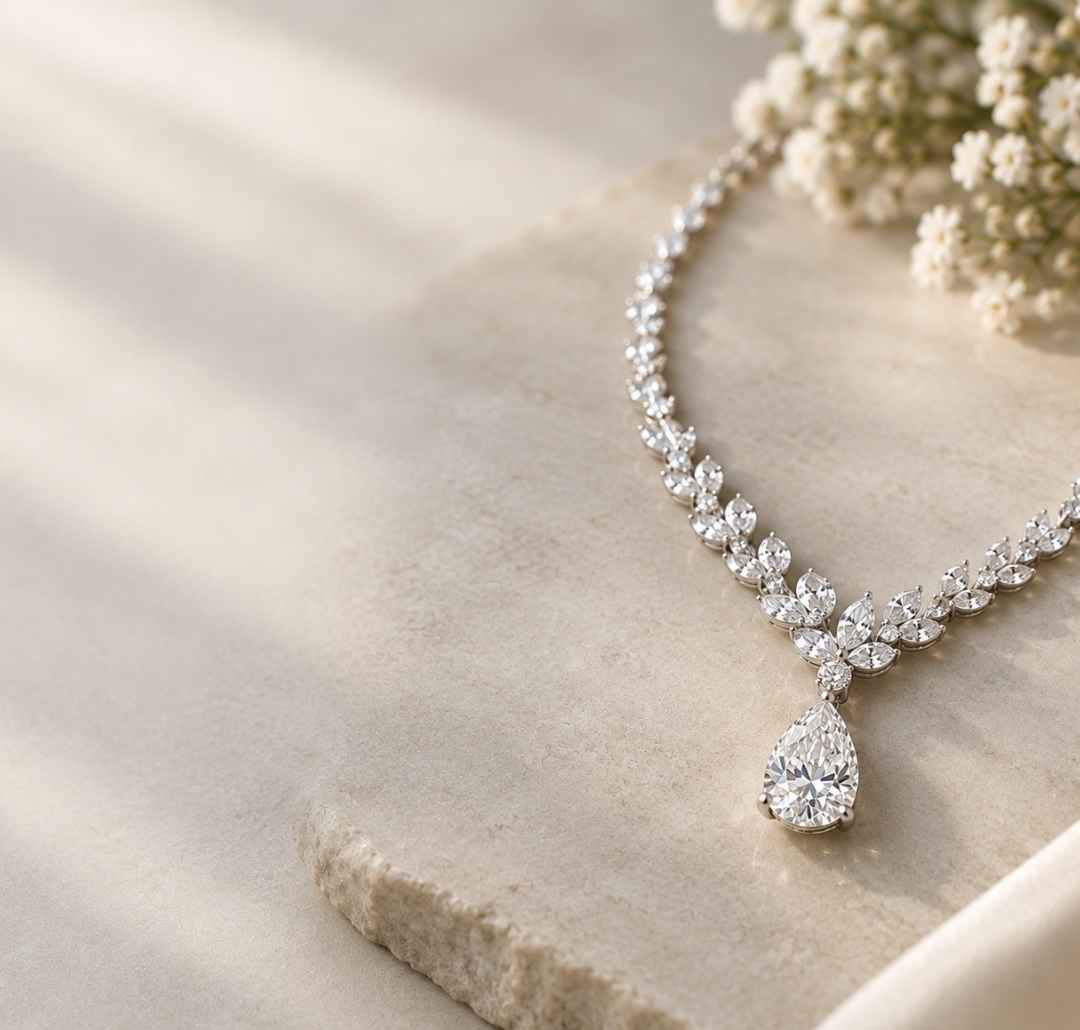
Lab Grown Diamond Necklace: Best Designs & Prices in India 2026
A diamond necklace is rarely an impulse purchase. You want to know which style suits your outfits, what a fair price looks like and how to tell a well-made piece from an overpriced one.
This guide helps you compare the main lab grown diamond necklace designs, understand what drives the price and choose with confidence, whether it is for a wedding, an anniversary or everyday wear.
What Is a Lab Grown Diamond Necklace?
A lab grown diamond necklace is a piece of jewellery set with diamonds grown in a controlled laboratory instead of being mined.
Lab grown diamonds are real diamonds. They are made of carbon arranged in the same crystal structure as natural diamonds and share the same hardness and optical properties. They are grown mainly through two methods: HPHT (high pressure, high temperature) and CVD (chemical vapour deposition).
They are different from diamond simulants such as cubic zirconia and moissanite. Simulants only look similar and have a different chemical makeup. A lab grown diamond differs from a natural one only in origin, and a gem lab can identify that with specialised equipment.
Because the stone is not enough on its own, always look at the diamond specifications (carat weight, cut, colour, clarity) and whether an independent grading report is available.
Why Choose a Lab Grown Diamond Necklace?
Buyers usually choose lab grown diamond necklaces for practical reasons:
- Design range: From a single solitaire pendant to a statement piece with many stones.
- Specifications you can compare: Reputable pieces list carat weight, colour, clarity and metal details, so you can compare like with like.
- Pricing flexibility: Lab grown diamonds are generally priced differently from natural diamonds of similar size and quality, so some buyers choose a larger or better-quality stone within the same budget. Always compare actual product pages rather than assuming.
- Everyday and occasion wear: A well-built piece works for office days as well as celebrations.
- Gifting: A necklace is easy to personalise by style, metal and length.
Treat a necklace as something you wear and enjoy. Do not buy it expecting investment returns.
Best Lab Grown Diamond Necklace Designs for Women
Solitaire Diamond Necklaces
A single stone on a fine chain. This is the classic choice for everyday wear and works with western outfits as well as simple kurtas and sarees. Buyers who like understated elegance usually prefer it.
Diamond Pendant Necklaces
A lab grown diamond pendant necklace has a pendant (heart, drop, bar, initial or other shape) hanging from a chain. It suits first-time diamond buyers and gifting, and sits well on round and V-necklines.
Halo Diamond Necklaces

A centre stone surrounded by smaller diamonds makes the pendant look larger and brighter. It works well for parties, dinners and festive evenings. Choose it if you want visible sparkle without a heavy necklace.
Floral Diamond Necklace Designs

Petal and flower motifs add a feminine, traditional feel. They pair well with ethnic wear such as sarees, suits and lehengas, and are a popular gifting choice for festivals and weddings.
Minimalist Diamond Necklaces

Thin chains, tiny stones and clean lines. These are suitable for daily wear and office wear, and they layer well with other chains. Pick this if you want something you can wear without thinking about it.
Statement Diamond Necklaces

Multiple stones, broader designs or collar-style layouts. They suit weddings, receptions and big celebrations. They look best with simple necklines and minimal other jewellery.
Contemporary and Geometric Designs

Bars, hexagons, interlocking shapes and abstract patterns. They suit modern wardrobes and buyers who prefer something distinctive over a traditional motif.
Availability of these styles at The6C should be confirmed against the live collection before publishing. [CONFIRM AVAILABLE STYLES]
Lab Grown Diamond Necklace Price in India 2026
The price of a lab grown diamond necklace in India depends on what is in the piece, not on how it looks in a photograph. Two necklaces can look almost identical online and still be priced very differently.
| Pricing Factor | How It Affects Cost | What Buyers Should Check |
|---|---|---|
| Total carat weight | More diamond weight generally raises the price, and larger single stones cost disproportionately more than several small ones | Total carat weight, and whether it is one stone or many |
| Cut | Better cut gives more brilliance and usually costs more | Cut grade, where the report or listing provides it |
| Colour | Colourless grades usually cost more than near-colourless | Colour grade range |
| Clarity | Fewer visible inclusions usually mean a higher price | Clarity grade range |
| Diamond shape and number of stones | Shape, and how many stones are used and how well they are matched, change both diamond and labour cost | Shape, stone count and setting type |
| Metal type and weight | Gold karat, metal colour and the weight of gold in the chain and setting add to the cost | Karat (14K, 18K), gold weight, BIS hallmark |
| Design and craftsmanship | Intricate settings, handcrafted detail and secure construction take more skill and time | Setting type, clasp, finish quality |
| Certification and specifications | Independently graded stones come with verifiable details | Report issuer, report number, what the report covers |
Why two similar necklaces can have different prices
Look at these three things first:
- Total carat weight: A necklace with 0.50 ct total may look similar to one with 0.30 ct total.
- Quality grades: Two stones of the same size can sit at very different colour and clarity levels.
- Gold content: A heavier chain or a higher karat costs more even if the pendant looks the same.
For current The6C pricing, check the collection page directly. Prices change, and this article does not quote figures that have not been verified. [ADD VERIFIED PRICE REFERENCE FROM LIVE PRODUCT PAGES IF AVAILABLE]
How to Choose the Right Lab Grown Diamond Necklace
Use this checklist before you buy:
- Occasion and use: Decide whether it is for daily wear, work or special events. Daily-wear pieces should be lighter and more secure.
- Necklace style: Match the style to your wardrobe (see the designs above).
- Diamond shape: Round gives maximum sparkle, while pear, oval and marquise give a more distinctive look.
- Carat weight: Check total carat weight, not just the size of the pendant.
- Cut, colour and clarity: Cut affects sparkle the most. Colour and clarity matter, but small differences are often hard to see in a pendant.
- Metal type: Yellow, white and rose gold each change the look. Check the karat and hallmark.
- Necklace length: Choose based on neckline and styling (see the length section below).
- Certification: Check whether a grading report is provided and from which lab.
- Clasp and construction: Look for a secure clasp, firm settings and a well-finished chain.
- Budget: Set a range first, then compare total carat weight, grades and gold weight within it.
Best Lab Grown Diamond Necklaces for Different Occasions
- Everyday wear: A minimalist solitaire or a small pendant on a fine chain.
- Office wear: A simple pendant or a delicate geometric design that stays subtle.
- Parties and evening events: A halo pendant or a multi-stone design with more sparkle.
- Weddings and bridal styling: A lab grown diamond necklace for wedding use is usually a statement or floral design, chosen to complement the neckline of the bridal outfit.
- Anniversaries: A heart, floral or classic solitaire pendant carries sentiment well.
- Birthday gifting: A pendant necklace is the easiest to get right, especially if the recipient prefers simple jewellery.
- Festive occasions: Floral and halo designs work well with ethnic wear.
Which Necklace Length Is Best?
No single length is best for everyone. These are the common options:
| Length | Typical Position | Works Well With |
|---|---|---|
| 14–16 inches (choker) | Close to the base of the neck | Open necklines, strapless outfits |
| 16–18 inches (princess) | Just below the collarbone | Most necklines, everyday wear |
| 20–24 inches (matinee) | Lower on the chest | Higher necklines, layered looks |
| 28 inches and above (opera) | Long, can be doubled | Formal wear, layering |
Neckline, pendant size and comfort matter more than rules. A larger pendant usually looks better on a slightly longer chain, and a plunging neckline works well with a longer piece. An adjustable chain gives you more than one option.
Lab Grown Diamond Necklace vs Natural Diamond Necklace
| Aspect | Lab Grown Diamond | Natural Diamond |
|---|---|---|
| Origin | Grown in a laboratory | Formed in the earth over a very long period |
| Physical and chemical properties | Carbon, same crystal structure and hardness | Carbon, same crystal structure and hardness |
| Appearance | Not distinguishable to the naked eye | Not distinguishable to the naked eye |
| Certification | Graded by gem labs, and the report states the origin | Graded by gem labs, and the report states the origin |
| Pricing | Typically priced differently from natural diamonds of similar specifications | Pricing depends on rarity and market conditions |
| Design choices | Wide range of designs | Wide range of designs |
| Resale | Secondary market is less established, so do not assume resale value | Secondary market is more established, though resale prices are not guaranteed either |
Both are real diamonds. The choice depends on your priorities, such as budget, preference about origin and how you plan to use the piece.
How to Check the Quality of a Lab Grown Diamond Necklace
- The 4Cs: Carat (weight), cut (how well the stone is proportioned), colour (how colourless it is) and clarity (how free it is of inclusions).
- Grading reports: Reports from independent gem labs describe a stone’s measurements and grades. Check that the report number matches the product.
- What a report does and does not establish: It describes the diamond’s characteristics and origin. It does not describe the quality of the metalwork, the chain or the clasp.
- Metal purity: Ask for the karat, gold weight and BIS hallmark details.
- Product description: A good listing states total carat weight, stone count, colour and clarity range, metal and length. If these are missing, ask before buying.
Do not state The6C’s certification details unless confirmed. [ADD VERIFIED CERTIFICATION DETAILS]
How to Care for a Lab Grown Diamond Necklace
- Clean it gently with lukewarm water, a drop of mild soap and a soft brush, then dry with a soft cloth.
- Store it separately in a soft pouch or lined box so the chain does not tangle or scratch.
- Remove it before swimming, bathing, cleaning or applying perfume and hairspray.
- Check the clasp and settings regularly for looseness.
- Get it inspected by a jeweller from time to time, especially if you wear it daily.
Is a Lab Grown Diamond Necklace a Good Gift?
Yes, it suits many occasions, including birthdays, anniversaries, weddings and milestone celebrations such as a promotion or a new home.
To choose well, think about the recipient:
- Style: If she wears simple jewellery, pick a solitaire or a minimalist pendant. If she likes bold pieces, pick a halo or statement design.
- Metal: Look at what she already wears most, such as yellow gold or white metals.
- Use: A lighter piece suits daily wear, while a bigger design suits occasions.
Ready to look at actual designs? Browse The6C’s necklace collection and compare styles by occasion and specifications. [CTA: Explore Lab Grown Diamond Necklaces → NECKLACE COLLECTION URL]
Frequently Asked Questions
1. Are lab grown diamond necklaces real diamond jewellery?
Yes. A lab grown diamond has the same chemical composition and crystal structure as a natural diamond. It differs only in origin. This is why it is different from cubic zirconia or moissanite, which are diamond simulants.
2. How much does a lab grown diamond necklace cost in India in 2026?
The price depends on total carat weight, diamond quality, metal and design, so there is no single figure. A simple pendant costs far less than a multi-stone statement piece. Check current listings on the product page for the exact price.
3. Which lab grown diamond necklace design is best for everyday wear?
A minimalist solitaire or a small pendant on a fine chain is usually the most practical. It is light, goes with most outfits and does not catch on clothing. Make sure the clasp and settings are secure.
4. Are lab grown diamond necklaces suitable for weddings?
Yes. Floral, halo and statement necklaces are popular for weddings and receptions. Choose the design according to the bridal outfit’s neckline and the other jewellery being worn, so the necklace complements rather than competes.
5. How do I choose the right necklace length?
Start with your neckline. Shorter lengths (16–18 inches) sit near the collarbone and suit most outfits, while longer lengths work with higher necklines or layering. A larger pendant often looks better on a slightly longer chain. An adjustable chain gives you flexibility.
6. What affects the price of a lab grown diamond necklace?
Mainly total carat weight, cut, colour and clarity, the number and shape of stones, the type and weight of the metal, the design and craftsmanship, and certification. Two similar-looking necklaces can differ on any of these.
7. Are lab grown diamond necklaces certified?
Many lab grown diamonds are graded by independent gem labs, but this varies by product. Always check the product page for certification details and whether the report number matches the piece you are buying.
8. How do lab grown diamonds differ from natural diamonds?
They differ in origin only. Both are carbon with the same hardness and appearance. Pricing differs, and resale markets are developed differently. Gem labs can tell them apart using specialised equipment.
9. Can a lab grown diamond necklace be worn every day?
Yes. Diamonds are very hard, so the stone itself is durable. For daily wear, pick a secure setting and clasp, remove it before swimming or cleaning, and have it checked periodically.
10. Where can I buy a lab grown diamond necklace online in India?
Buy from a jeweller that clearly lists carat weight, grades, metal details and certification. You can browse The6C’s necklace collection online and compare designs.