
Article: Colored Diamond Jewellery Trends for 2026
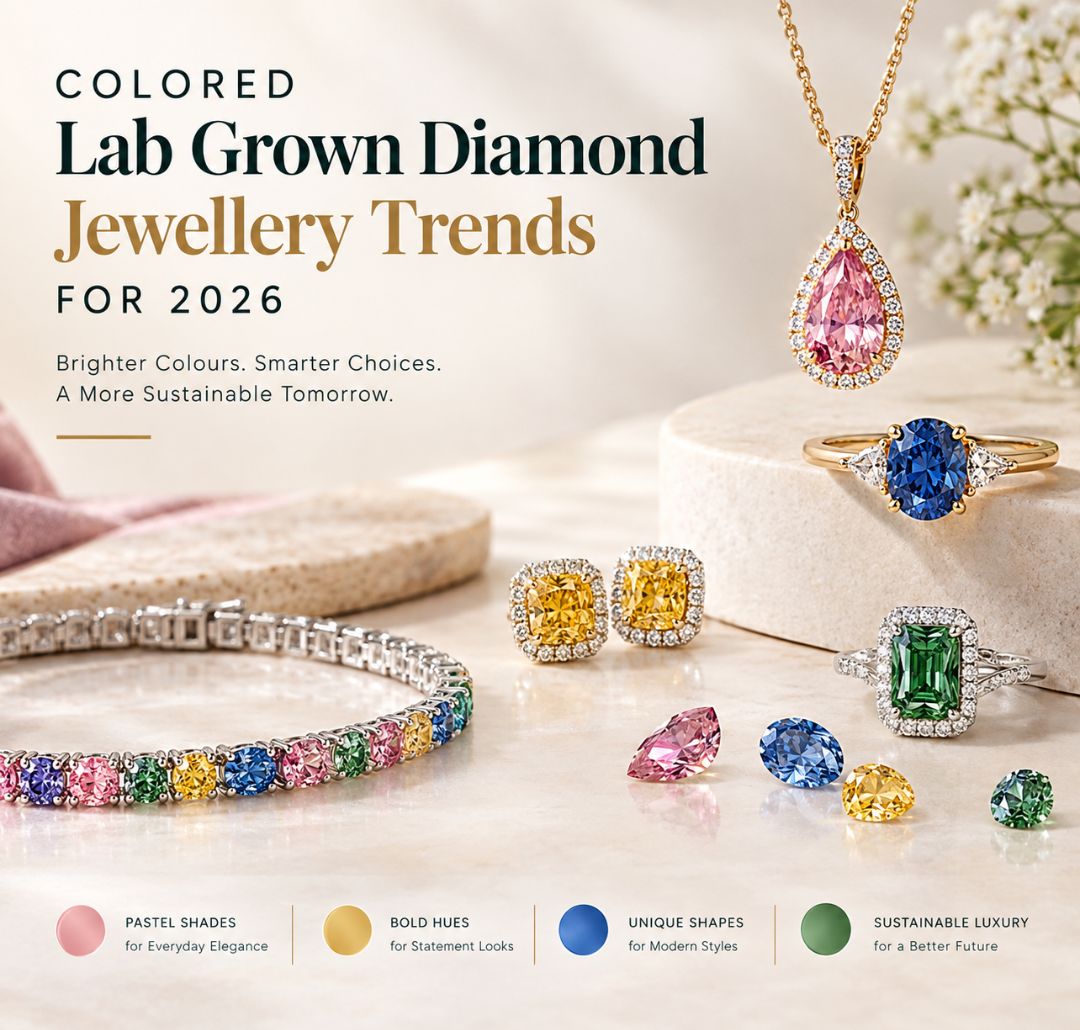
Colored Diamond Jewellery Trends for 2026
Colored diamonds have quietly moved from a niche collector's interest to a mainstream jewellery choice. Buyers who once defaulted to a classic white diamond are now asking a different question: what does this stone say about me? That shift is driving 2026's biggest jewellery story colour, cut, and personalization taking centre stage over pure carat weight.
What colored diamond jewellery trends are expected to be popular in 2026? Soft pink and warm champagne tones for everyday wear, bold yellow and blue stones as standalone statement pieces, fancy cuts like oval and cushion that flatter colour saturation, mixed-metal settings that let one stone look different depending on the gold around it, and jewellery built around personal meaning rather than trend-chasing alone.
At a Glance: 2026 Colored Diamond Trends
- Pink diamonds continue to lead demand for romantic and bridal-adjacent pieces
- Yellow diamonds are being styled as bold, standalone statement jewellery
- Blue diamonds are gaining traction in evening and formal jewellery
- Champagne and brown tones are favoured for understated, everyday luxury
- Green diamonds are appearing more often in nature-inspired designs
- Mixed-colour and multi-stone jewellery is replacing single-tone simplicity
- Fancy cuts — oval, cushion, radiant, pear — are preferred over round brilliants for colour depth
- Personalized and meaning-driven pieces are shaping how buyers choose colour
Top Colored Diamond Jewellery Trends for 2026
1. Pink Diamond Jewellery for Romantic Statement Pieces
Pink remains the colour most buyers reach for first. Soft, pale pink diamonds suit everyday rings and delicate pendants, while more saturated pink stones work well in earrings or as a ring centrepiece where the colour needs room to stand out. Pink diamond jewellery is showing up across engagement-style rings, stacking bands, and drop earrings, largely because the colour reads as personal rather than purely decorative. For engagement jewellery specifically, buyers are pairing pink centre stones with simple white-diamond bands so the colour stays the focal point.
2. Yellow Diamonds for Bold and Modern Jewellery
Yellow diamond rings and earrings are being chosen by buyers who want a piece that doesn't blend in. The colour has strong contrast against white metals like platinum or white gold, which makes even a modestly sized stone look prominent. Warm-toned styling — yellow gold settings, layered with other warm accessories — is a common direction for 2026, though the white-metal contrast look remains equally popular for those who want the stone itself to dominate the design.
3. Blue Diamonds for Sophisticated Jewellery
Blue diamond jewellery is trending toward more formal and evening use — necklaces, drop earrings, and cocktail rings rather than daily-wear pieces. Lighter blue tones read as cool and understated, suitable for office or day-to-evening jewellery, while darker, more saturated blues are being used as clear statement pieces for events. Because blue is a less common diamond colour, even a single well-placed blue stone tends to become the focal point of a design without needing additional embellishment.
4. Champagne and Brown Diamonds for Understated Luxury
Champagne and brown diamonds are appealing to buyers who want something distinct from a traditional white diamond without the boldness of pink, yellow, or blue. These warmer, earthier tones work particularly well for everyday jewellery rings, bracelets, and stud earrings that need to hold up to daily wear while still feeling different from what's typically seen. The understated nature of these tones also makes them versatile across both casual and formal settings.
5. Green Diamonds and Nature-Inspired Jewellery
Green diamonds are still rare, but interest in nature-inspired jewellery design is bringing more attention to green tones generally. Buyers exploring this colour are typically doing so for its distinctiveness rather than for any claims around rarity or value — and it's worth noting that green diamond availability can vary significantly, so working with a jeweller who can clearly explain sourcing and certification matters here more than with more common colours.
6. Mixed-Color Diamond Jewellery
Single-tone simplicity is giving way to jewellery that combines colours deliberately — pink paired with white, yellow set alongside white accents, or blue diamonds used as smaller supporting stones around a white centre. These combinations create visual contrast without needing one oversized coloured stone, which makes mixed-colour pieces a practical way to introduce colour into jewellery that still needs to feel versatile.
7. Fancy Cuts Become More Important
The cut a colored diamond is given has a direct effect on how saturated and even the colour appears. Oval, pear, and cushion cuts are being favoured because they tend to concentrate colour more visibly than a round brilliant cut. Emerald and radiant cuts are popular for buyers who want a more geometric, modern look, while marquise and heart shapes are being used in smaller accent stones and pendant designs. For colored diamonds, cut selection is genuinely as important as colour selection — the same stone can look noticeably different depending on how it's faceted.
8. Colored Diamond Halo and Cluster Designs
Halo settings a coloured centre stone surrounded by smaller white diamonds remain a popular way to make a colored diamond appear larger and more prominent. Cluster designs, which group several smaller coloured stones together, are also gaining ground as an alternative to a single large centre stone, particularly for buyers working within a defined budget who still want visual impact.
9. Two-Tone and Mixed-Metal Settings
The metal a colored diamond is set in changes how the stone reads. Yellow gold tends to warm up pink and champagne stones, rose gold intensifies pink tones further, and white gold or platinum lets cooler colours like blue stand out with more contrast. Two-tone settings — combining, say, rose gold and platinum in a single piece are being used to let one stone show two different characters depending on the angle and light.
10. Personalized Colored Diamond Jewellery
Perhaps the most consistent theme across 2026 is personalization. Buyers are choosing colours tied to birthstones, anniversaries, or personal significance rather than simply following what's popular. Initial pendants set with a meaningful colored diamond, custom anniversary rings, and made-to-order pieces built around a specific stone colour are becoming a bigger share of what buyers are asking for, reflecting a broader shift toward jewellery as a personal statement rather than a purely decorative purchase. For buyers who already know the colour and stone they want, working through a dedicated customisation process — choosing the diamond shape, solitaire size, and ring size directly is often a more direct route than searching for the exact piece ready-made.
Natural vs Lab-Grown Colored Diamonds: What Should You Know?
Natural and lab-grown colored diamonds are chemically and physically the same material both are crystallized carbon with the same hardness and optical properties. The difference lies in origin: natural colored diamonds form over geological timescales underground, while lab-grown diamonds are created in controlled laboratory conditions using high-pressure, high-temperature (HPHT) or chemical vapour deposition (CVD) methods.
This difference in origin does affect a few practical factors for buyers:
- Color availability — lab-grown production allows for more consistent access to certain colours, since colour can be introduced or enhanced more predictably during the growth process
- Pricing — lab-grown colored diamonds are generally more accessible in price than natural stones of comparable colour and size, though pricing depends heavily on the specific stone
- Customization — because supply is less constrained, lab-grown stones often offer more flexibility for custom cuts, sizes, and colour intensities
- Certification — both natural and lab-grown diamonds should come with grading reports from a recognized gemological laboratory; the report should clearly state whether the stone is natural or laboratory-grown
It would be inaccurate to claim that lab-grown diamonds are automatically more sustainable or more ethical than natural ones both involve resource-intensive production processes, and claims about environmental impact vary by producer and should be evaluated on a case-by-case basis. The most reliable step for any buyer, regardless of which type they choose, is to check the diamond's certification and confirm exactly what is being purchased before finalizing. If you want a closer look at how lab-grown stones are produced and graded, it's worth reading through a detailed breakdown of conscious, lab-grown diamonds before comparing specific pieces.
How to Choose a Colored Diamond Jewellery Style in 2026
| If You Want | Consider |
|---|---|
| Romantic & Feminine | Pink |
| Bold & Vibrant | Yellow |
| Elegant & Cool-Toned | Blue |
| Warm & Understated | Champagne/Brown |
| Nature-Inspired | Green |
| Unique & Personalized | Mixed Colors |
These are style directions rather than fixed rules the right colour ultimately comes down to personal preference, skin undertone, and the occasion the piece is meant for.
Colored Diamond Jewellery Trends by Jewellery Type
Colored Diamond Rings
Rings remain the most popular category for colored diamonds, with pink and champagne tones leading for everyday and engagement-style pieces. Oval and cushion cuts are the preferred shapes for ring centre stones, and halo settings continue to be a common choice for making the colour visually prominent. For those exploring dedicated designs, browsing The6C's ring collection is a useful first step before deciding on colour and cut.
Colored Diamond Earrings
Earrings offer more room for bolder colour choices since they're viewed at a slight distance rather than up close. Yellow and blue diamond earrings, in particular, are trending as statement pieces for evening wear, while smaller pink or champagne studs are being chosen for daily use. The6C's lab-grown diamond earrings collection spans everything from simple studs to convertible designs that can be styled for both day and evening wear.
Colored Diamond Pendants & Necklaces
Pendants are where personalization shows up most clearly — single coloured stones chosen for birthstone or sentimental significance, often set simply so the colour and meaning stay the focus. Necklaces with mixed-colour clusters are appearing more in formal and festive contexts. The6C's pendant collection and ready-to-ship necklaces are both worth browsing for pieces built around a single meaningful stone.
Colored Diamond Bracelets
Bracelets tend to favour smaller, more numerous coloured stones — tennis-style bracelets with alternating colours, or champagne and brown tones set in warm gold for everyday wear that can transition easily from office to evening. The6C's bracelet collection includes fancy-shaped stone settings across several metal tones for this kind of everyday layering.
Colored Diamond Engagement Rings
Colored diamond engagement rings, particularly in pink and champagne tones, are being chosen by couples who want something distinct from a traditional white diamond solitaire. Fancy cuts paired with a simple halo or white-diamond band tend to be the preferred approach, keeping the coloured stone as the clear focal point without overwhelming the design. Since engagement rings are also where sizing and stone selection matter most, this is often a good candidate for customising the design rather than choosing a fixed, ready-made piece.
How to Style Colored Diamond Jewellery in 2026
- Everyday styling: smaller champagne, brown, or pale pink stones in simple settings that don't compete with daily outfits
- Office/formal styling: understated pieces — a single coloured stud or a slim pendant — that add colour without feeling overly decorative
- Wedding styling: pink or mixed-colour pieces paired with white diamond accents work well alongside traditional bridal jewellery
- Festive occasions: bolder yellow, blue, or cluster designs suit the heavier, more elaborate jewellery typically worn during celebrations
- Evening/party styling: saturated blue or yellow statement pieces, worn as a single strong element rather than layered with too much else
- Stacking and layering: mixing coloured stones with plain metal bands or chains keeps the colour as the visual anchor without cluttering the look
- Matching with skin undertones: warmer colours like yellow and champagne tend to suit warmer undertones, while blue and pink often work well against cooler undertones — though personal preference should always take priority over strict rules
What to Look for When Buying Colored Diamond Jewellery
Colored diamonds shouldn't be evaluated with the same visual priorities used for traditional colorless diamonds, where clarity and brilliance are the main focus. For coloured stones, colour intensity and evenness often matter more than absolute clarity.
- Color — the specific hue and how true it appears in different lighting
- Intensity/saturation — richer, more saturated colour is generally more valued than a very pale tone, though this comes down to personal preference
- Cut — directly affects how the colour appears; certain cuts concentrate colour more effectively
- Clarity — important, but typically weighed less heavily than colour for fancy-colored stones
- Carat weight — larger stones aren't automatically better if the colour or cut isn't well matched to the setting
- Certification — always confirm grading from a recognized gemological laboratory, and check whether the stone is natural or lab-grown
- Metal — the setting metal changes how the colour reads, as covered above
- Setting quality and craftsmanship — prongs, bezels, and finishing should securely hold and complement the stone
- Return/exchange policy — confirm this clearly before purchase, especially for custom pieces
- Customization options — ask whether cut, metal, and design can be adjusted to suit your preferences
Frequently Asked Questions
What are the biggest colored diamond jewellery trends for 2026?
Pink and champagne tones for everyday and bridal-adjacent pieces, bold yellow and blue diamonds as statement jewellery, fancy cuts like oval and cushion for better colour concentration, mixed-colour designs, and a strong shift toward personalized, meaning-driven jewellery choices over purely trend-based ones.
Which colored diamond is most popular in 2026? Pink continues to be the most consistently requested colour across rings, earrings, and pendants, largely because it works for both everyday wear and more romantic or bridal-style pieces. Yellow and champagne tones follow closely behind for buyers wanting bolder or more understated alternatives.
Are colored diamonds trending in 2026?
Yes. Buyers are increasingly moving beyond traditional white diamonds toward jewellery that reflects personal style, with colour, cut, and customization playing a bigger role in purchase decisions than in previous years.
What is the most popular color for diamond jewellery?
Pink is currently the most popular colour, followed by yellow and champagne/brown tones, though preference varies significantly by jewellery type and occasion.
Are lab-grown colored diamonds available?
Yes, lab-grown colored diamonds are widely available and often offer more consistent colour options and pricing flexibility compared to natural stones. They should still come with proper certification confirming their origin and grading.
Are colored diamonds good for engagement rings?
Colored diamonds, particularly pink and champagne tones, are increasingly chosen for engagement rings by couples wanting something distinct from a traditional white diamond. The choice ultimately depends on personal style rather than any fixed convention.
Which diamond color looks best in gold?
Yellow gold tends to complement warm-toned stones like yellow, champagne, and pink diamonds by enhancing their warmth. Cooler tones like blue diamonds are often set in white gold or platinum for stronger contrast, though this comes down to personal preference.
What is the difference between natural and lab-grown colored diamonds?
Natural colored diamonds form underground over geological timescales, while lab-grown diamonds are created in controlled lab conditions. Both share the same physical and chemical properties; the key differences for buyers are origin, price, colour availability, and certification.
Are colored diamonds more expensive than white diamonds?
This varies widely depending on the specific colour, intensity, size, and whether the stone is natural or lab-grown. Rather than assuming a fixed price relationship, buyers should compare specific stones and always check certification and pricing details directly.
How do I choose a colored diamond jewellery design?
Start with the colour that appeals to you personally, then consider the occasion the piece is for, your preferred metal tone, and whether you want a single statement stone or a mixed-colour design. Cut and setting style should be chosen to complement the specific colour and intensity of the stone.


